Chapter 6, Part 1: The Franco-Syrian Treaty of 1936 and France's Refusal to Ratify It
The High Commissioner, de Martel, concluded that in this gloomy atmosphere at home and abroad, the best way to bring calm to Syria was to negotiate with the leaders whom the people respected and wanted. He put this view to his government, which encouraged him to proceed in this direction and to deal directly with the men of the National Bloc, as the only political force in the country that could rightly speak on its behalf.
But the men of the Bloc, who had experienced the tricks and maneuvers of the French, wanted proof of French good intentions, and that the French were serious in seeking an honorable agreement.
As a token that would smooth the way to fruitful contacts between the two sides, they asked for the dismissal of the government of Sheikh Taj and for free elections supervised by a neutral government.
The High Commissioner agreed to these demands. He dismissed the cabinet of the Sheikh-judge (Sheikh Taj) and formed a neutral cabinet under Ata al-Ayyubi on 23 February 1936. The Bloc men and the High Commissioner agreed that a negotiating delegation of theirs would go to Paris to negotiate with the French government a new treaty they could accept, one that would "be no less than the rights of our Iraqi brothers in their treaty concluded with Britain".
The High Commissioner announced his acceptance of this principle, and that France agreed to restore Syrian unity and give up the partition.[1]
The Syrian delegation was formed under Hashim al-Atassi, with Faris al-Khouri, Jamil Mardam, Saadallah al-Jabiri, Mustafa al-Shihabi and Edmond Homsi as members (the last two being ministers in Ata al-Ayyubi's cabinet), accompanied by Naim Antaki and Ahmad al-Lahham as secretaries. A presidential decree to this effect was issued on 14 March 1936.
The delegation reached Paris on 25 March, accompanied by the High Commissioner himself, a gesture taken as an honor to the delegation and as an expression of France's good intentions.
While the negotiations with the Foreign Ministry were going on, telegrams of support for the delegation kept arriving at the ministry from Syrian citizens, especially from the people of the Alawite Mountain and Jabal Druze and the people of Sidon and Jabal Amil, who strongly demanded their return to their mother, Syria. Even so, some fanatics among the non-Muslims clung to the skirts of the Mandate, to prevent the treaty if possible, or, if they could not stop its conclusion, to have clauses written into it safeguarding their "rights and security". Some of the Muslims who collaborated with the occupier were not pleased by the latest turn of events either.
What made the negotiations somewhat easier was the success of the left-wing parties in the French elections at that time, especially the Socialist Party led by Léon Blum,[2] who became prime minister and completed the negotiations with the Syrians. A treaty was signed between Hashim al-Atassi, head of the Syrian delegation, and Léon Blum for the French government on 9 September 1936.
It was stipulated that it be ratified by the parliaments of the two countries.
The whole country rejoiced at the signing of this treaty, because those who had signed it had the trust of the citizens, and it never crossed anyone's mind that these leaders would give away a grain of their country's rights.
The people expressed their thanks and gratitude to them by holding great celebrations for them when they returned to work for its ratification.
Faris al-Khouri described the treaty as "the miracle of the twentieth century", Jamil Mardam called it "the bride of the East", and Saadallah al-Jabiri, praising France's generosity, said: "All that is left for France is to give us Marseilles."
The statement Hashim al-Atassi issued to the Syrian people on 22 September 1936 said: "You have fought the holiest of struggles and striven the noblest of strivings, and carried the banner of freedom and independence, and God willed to complete His favor upon you, so that you have reached this day, which is one of your shining days, indeed one of the famous days of the Arabs."
He described France as "our free ally and our generous friend".
The distinctive feature of this treaty is that it abolishes the mandate and recognizes the independence of Syria. It does, however, give France rights set out in a number of annexes. Faris al-Khouri said of these annexes that they were "limited in time and open to amendment by special laws".
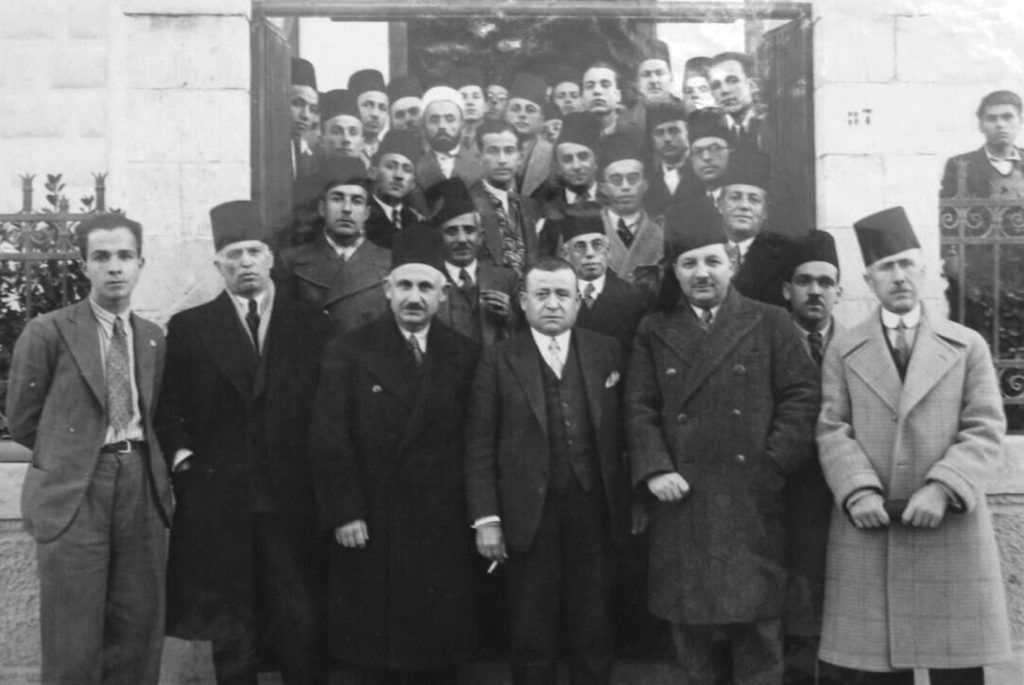
To ratify this treaty, the High Commissioner set the date of the parliamentary elections for 30 November 1936. The elections were held in two stages under the legislation in force, and the men of the National Bloc threw their whole weight into them to elect 104 deputies. Rushdi al-Kikhya was one of the candidates, as a member of the council of the National Bloc.
The people honored them: the list of the nationalists and their supporters won almost unanimously throughout the country.
And so Rushdi entered the chamber of the Chamber of Deputies for the first time, to walk the honorable road on which fate had set him.
Nothing was left for the President of the Republic, Muhammad Ali al-Abid, and the Prime Minister, Ata al-Ayyubi, but to resign, since the holders of the popular mandate were now in a sound legal position.
The new Chamber met on 21 December 1936 and elected Faris al-Khouri as its Speaker, and on the same day elected Hashim al-Atassi President of the Republic.[3]
The new President issued a decree forming a new cabinet under Jamil Mardam. The newly created Ministry of Foreign Affairs was entrusted to Saadallah al-Jabiri, in addition to the Ministry of the Interior; the newly created Ministry of National Defense was entrusted to Shukri al-Quwatli; and Dr. Abd al-Rahman al-Kayyali took the Ministries of Justice and Education.
These were the great leaders of the National Bloc, and they had the people's trust. So that there should be no slackness on France's part, the new Syrian government submitted the draft treaty to the Chamber of Deputies for its approval on the second day after it was formed. The Chamber approved it after an ordinary debate, and the President of the Republic promulgated it by law on 27/12/1936.
The treaty did not lack opponents in Syria, who faulted it for the privileges it granted France. At the head of its critics was the group of the "Popular Organization" (al-Hay'a al-Sha'biyya), formed under the leadership of Dr. Abd al-Rahman Shahbandar. Among its men who had broken away from the National Bloc were Zaki al-Khatib and Dr. Munir al-Ajlani. These opponents regarded the treaty as worse than the mandate.
Even so, the men of the Bloc stood firm in their positions, in their deep conviction that the victory they had won in obtaining this treaty was the most they could achieve in the negotiations.
Regrettably, however, the French government began to stall and procrastinate over ratifying the treaty it had signed, and started pleading serious obstacles in its way.
The Syrian government, for its part, took action and sent several delegations to Paris to persuade the French government and urge it to begin the ratification procedures. But stalling and procrastination were all the Syrian delegations got. The conduct of the French government angered the people of Syria, who took to the streets chanting against the French authority and attacking its policy.
What angered the Syrians still more was that the French High Commissioner took practical steps to make the Syrian government implement the system of religious communities he had issued on 13 March 1936 (known as Legislative Decree No. 60). On the face of it this system was in keeping with equality among citizens and freedom of conscience, since it allowed a citizen to change his religion or sect and to move from one religious community to another. But in the reality of the country it offended the feelings of the Muslims, who are the majority, because the religion of Islam forbids a Muslim to leave his religion, calls him an apostate, and the penalty for apostasy in Islam is death.[4]
The men of religion joined the demonstrations led by the political opponents, in order to oppose the implementation of the system of communities that the High Commissioner was demanding so as to embarrass the government and stir up strife in the country among its many communities.
French policy showed its colonial face, and the foreign affairs committee of the Chamber of Deputies decided to refuse ratification of the treaty.
I remember, as a student at the University of Paris, that the rapporteur of the foreign affairs committee of the French Senate, Henry Haye, issued a statement in December 1938 in which he denounced the treaty and said of Syria that "it is a mosaic of peoples". He criticized the treaty strongly and said France would send a commission to Syria to study the situation again on the spot.
We students got together to invite him to a meeting in a café on the Champs-Élysées to debate with him. He accepted the invitation and explained the French point of view. Some of the students answered him, but the difference between his overpowering personality and that of those debating with him was plain to everyone.
It happened that our teacher, Dr. Muhsin al-Barazi, was present at the meeting, and he took on the French speaker almost as an equal.. and we breathed a sigh of relief at his presence. But the French insisted on rejecting the treaty, and France sent Monsieur Puaux to Syria as the new High Commissioner at the beginning of January 1939. He soon clashed with the Syrian cabinet. He used the system of the communities as a pretext for embarrassing it, insisting on its implementation. "The Prime Minister (Jamil Mardam Bey) replied that he accepted. But he made it a condition that the Chamber of Deputies approve it."[5] Thereupon the High Commissioner sent the government an ultimatum, and it decided to resign on 18 February 1939.
What we believe is that France began to obstruct the ratification of the treaty under pressure from the Turkish government and its allies. The warning signs of the Second World War were showing their horns over the world, as the specter of the Nazi regime in Germany and the Fascist regime in Italy loomed larger. England and France were seeking to win Turkey's favor, claiming that they needed it.
I do not understand the reality of this need from the military and strategic point of view.
Endnotes:
[1] On this subject see Dr. Dhuqan Qarqut, Al-Mashriq al-Arabi fi Muwajahat al-Isti'mar (The Arab East in the Face of Colonialism), p. 396.
[2] Léon Blum was a Jewish socialist leader who, with his companions, was brought before an extraordinary court after France's defeat by the German forces in 1940. They were charged with "failing to prepare the French nation for war". The court sat in the town of Riom in central France. It handed down no sentences.
[3] I read in the newspaper al-Qabas, issue of (31) December 1936, p. 3, the following:
"The elected Chamber of Deputies agreed that the deputies' allowances should be as follows:
100 Syrian pounds a month and 300 pounds as an annual allowance. Some citizens demanded that the salary be reduced to only 50 pounds a month. A writer in the paper commented on this proposal saying: If a deputy accepts this salary, he will have to lodge at the khan and eat in the eating houses of the Ali Pasha market. But if you want him as a representative of the nation who stays at the Umayya Hotel or the Orient Palace, rides in a car and wears a morning coat and a dinner jacket, and then you give him only fifty notes, that means you want a deputy for nothing.."
[4] The three imams al-Shafi'i, Malik and Ibn Hanbal require that the apostate be called on to repent within three days. Abu Hanifa, however, regards calling for repentance as optional. He does not accept the repentance of a woman, because in his view she must be brought back to Islam by compulsion.
We would point out that international covenants allow every person to change his religion as he wishes. Article 18 of the International Bill of Human Rights adopted by the General Assembly of the United Nations on 10 December 1948 provides that "everyone has the right to freedom of thought, conscience and religion. This right includes his freedom to change his religion.." Article 18 of the International Covenant on Civil and Political Rights adopted by the United Nations on 16 December 1966 supports this freedom. So does the fifth clause of the Proclamation of Tehran issued by the International Conference on Human Rights held in Tehran on 30 May 1968.. All the Arab states have signed these covenants. Only the Kingdom of Saudi Arabia has entered a reservation on freedom of belief (as far as I know).
[5] Walid al-Muallem, op. cit., p. 290.