Dr. AbdulWahab Homad
(1915-2002) • Aleppo • Damascus • Paris
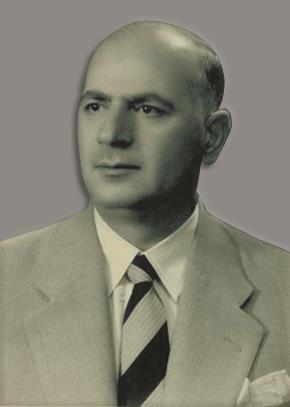
Syrian jurist, statesman and poet. Born in Aleppo and educated in Paris, he taught criminal law at the universities of Damascus, Rabat and Kuwait. He was general rapporteur of the committee that drafted Syria's 1950 constitution, sat for Aleppo in three parliaments, and held ministerial office seven times, including Education, Finance, and Justice in the first government of the Syrian-Egyptian union. In 1990 he was elected a full member of the Arabic Language Academy in Damascus.
"It will always remain my view that safeguarding human dignity is the most sacred duty that falls on the lawmaker and the man of government. No homeland can have dignity unless the dignity of every individual in it is protected."
AbdulWahab Homad, Advanced Studies in Comparative Criminal Jurisprudence (1987)
Early years in Aleppo
AbdulWahab Homad was born in Aleppo in 1913, in the Bab al-Nairab quarter, though his birth was entered in the civil register in 1915, the year his official papers later used. His father, Mahmoud Homad (1875-1943), owned pistachio and olive orchards on the southern edge of the city and traded in wool. The orchards were later built over, and the area is still known as Hay Homad, the Homad quarter. His mother was Asoum al-Nabulsi, who died in 1962.
His father first sent him to the neighborhood kuttab, held in a mosque, where he learned to read and write and studied the Quran, and then moved him to al-Ansariyya primary school. It was not an easy move: the notables of the quarter distrusted state schools, which taught French, geography and other modern subjects they had never heard of.
School and first teaching posts
He went on to al-Sultani, then the only secondary school in Aleppo and known today as al-Ma'moun Secondary School. There he earned the Teachers' College certificate in 1933, the first Syrian baccalaureate in 1934, and the second, in philosophy, in 1936. His teacher of Arabic and literature, Sheikh Badr al-Din al-Na'sani, urged his pupils to memorize as much of the Quran and of good poetry as they could. Homad memorized a great deal, helped by a memory that went on astonishing his friends for the rest of his life.
After the Teachers' College he was posted to a primary school in al-Jazira, then to Deir ez-Zor and to the town of al-Bab, and in the 1937-1938 school year he returned to al-Sultani as an assistant teacher. In 1937 he also enrolled at the Institute of Law in Damascus and completed the first year. In 1938 he won a Ministry of Education competition for study in France and was sent to read Arabic literature at the University of Paris.
The Paris years (1938-1945)
He had hardly settled in Paris when the Second World War broke out in 1939, and he stayed seven years. Finding that literature did not take up all his time, he enrolled at the Faculty of Law as well as the Faculty of Letters at the Sorbonne. He took a licence in Arabic literature and a diploma from the Institute of Criminal Sciences in 1940, a licence in law in 1941, a higher diploma in criminal sciences in 1942, and a doctorate in law in 1944. His thesis, "The Punishment of Political Crime in Comparative Legislation," was published by the Institute of Criminal Sciences in its own series.
He also registered for a doctorate in literature on the poet Hafez Ibrahim and his age, but never finished it, because he went home in August 1945, as soon as the war was over and the sea crossing possible again. Throughout those years he kept a diary, later titled "Memoirs of an Arab Student at the Sorbonne, 1939-1945": his lectures and examinations, food shortages and prices, air raids and curfews, the liberation of Paris, the lives of his fellow Arab students, and the talks he gave to North African students. He came home convinced that democracy was the right form of government, and he held to that conviction for the rest of his life.
Professor of criminal law
Back in Syria he spent a year teaching Arabic literature at Aleppo's secondary school and at the Teachers' College. In 1946 Sati' al-Husri, who was reforming the country's schools and university, chose a group of graduates newly returned from France to teach at the Syrian University, and Homad was one of them. He moved to Damascus to teach criminal law at the Faculty of Law from the 1946-1947 academic year, and rose to assistant professor and then to the chair of criminal law. He gave most of his lectures without notes, in fine classical Arabic, and his students admired him for it.
His teaching was interrupted twice. On 12 March 1952 Adib al-Shishakli dismissed him for refusing to swear an oath barring civil servants from political activity, and he practiced law in Aleppo until he returned to the university in 1954. In 1959 he left teaching to work full time as a minister. After the secession of 1961 he chose not to return to Damascus University at all, and practiced law.
He then taught at Mohammed V University in Rabat (1964-1968), lecturing on criminal law and criminal procedure to undergraduate and postgraduate students, and at Kuwait University (1968-1983), where he taught penal law and criminal procedure for fifteen years. He headed the department of criminal law at all three universities and supervised a number of doctoral and master's theses. In 1983, despite Kuwait University's efforts to keep him, he asked it not to renew his contract and went home to Damascus to research, write and lecture. Looking back, he counted "thirty-seven years teaching the criminal sciences in three Arab universities."
Deputy for Aleppo and the 1950 constitution
He entered politics with the opposition that Rushdi al-Kikhya led in Aleppo against the National Bloc. In the elections of July 1947 he stood on al-Kikhya's list of young, educated candidates, alongside Nazim al-Qudsi, Maarouf al-Dawalibi and Ahmad Qanbar, and won a seat for Aleppo. In late 1948 he was among the founders of the People's Party at the Faloga conference in Lebanon. He was returned for Aleppo to the Constituent Assembly on 15 November 1949 and again in the elections of 10 September 1954, and sat until parliament was dissolved when the union was formed in 1958. When elections were held under the secession, he refused to stand, out of loyalty to the union.
The Constituent Assembly chose him as general rapporteur of its constitutional committee. He drafted the text and defended it before the Assembly for months, until it was adopted on 5 September 1950. The constitution had 166 articles and was the first of the independence era; its first article declared Syria a sovereign, democratic, parliamentary Arab republic, and the Syrian people part of the Arab nation. In 1949, encouraged by Dr. Constantine Zurayk, president of the Syrian University, he had tried to get free secondary and vocational education through parliament and failed. So he wrote it into Article 28 of the constitution: "Secondary and vocational education shall be free in state schools."
At the Assembly's request, the government of Dr. Nazim al-Qudsi honored him with the Syrian Order of Merit of the Excellent Class, its highest grade, and made him chairman of the State Laws Committee, charged with reviewing the laws in force and proposing the repeal of any provision that contradicted the new constitution. In 1950 he also worked with Georges Jabbara, a counselor at the Court of Cassation, and Judge Riad al-Midani on Syria's Code of Criminal Procedure, adapted from the Lebanese code, which in turn followed the French.
Seven times a minister
He held ministerial office seven times, and for a time also served as acting foreign minister:
- Education (August to November 1951), in the government of Hasan al-Hakim.
- Finance (September 1955 to June 1956), under Said al-Ghazzi.
- Education again (June to December 1956), under Sabri al-Asali, the months of the Suez war.
- Justice (March to October 1958), in the first government of the union.
- Treasury (October 1958 to August 1961), in the executive council of the Syrian region under Nur al-Din Kahala.
- Planning (August to September 1961), in the central government in Cairo, until the secession.
- Finance again (March to May 1963), in Salah al-Bitar's government after 8 March, from which he and his colleague Nihad al-Qasim resigned.
At Education he issued the decree that put free secondary and vocational education into effect, and over his two terms he sent more than six hundred students to universities in Egypt, Europe and the United States. He was the first to allocate study missions by governorate, which gave students from remote provinces, who lacked the teachers of the big cities, a fair share. The returning graduates, he wrote later, "filled a great gap in secondary and higher education." He was known, too, for small courtesies: as minister he would go to Dr. Zurayk's office to sign papers rather than make the university president come to him.
At Finance he did two large things. He moved the printing of Syria's banknotes to the press of the Government of Pakistan, ending a British printer's monopoly, and he negotiated a new agreement with the Iraq Petroleum Company, whose pipelines crossed Syria: the country's share rose from 13 million to 65 million Syrian pounds a year, with a further 85 million paid into the treasury for past years. He also took part in the efforts that brought Euphrates water to Aleppo.
The union and the secession
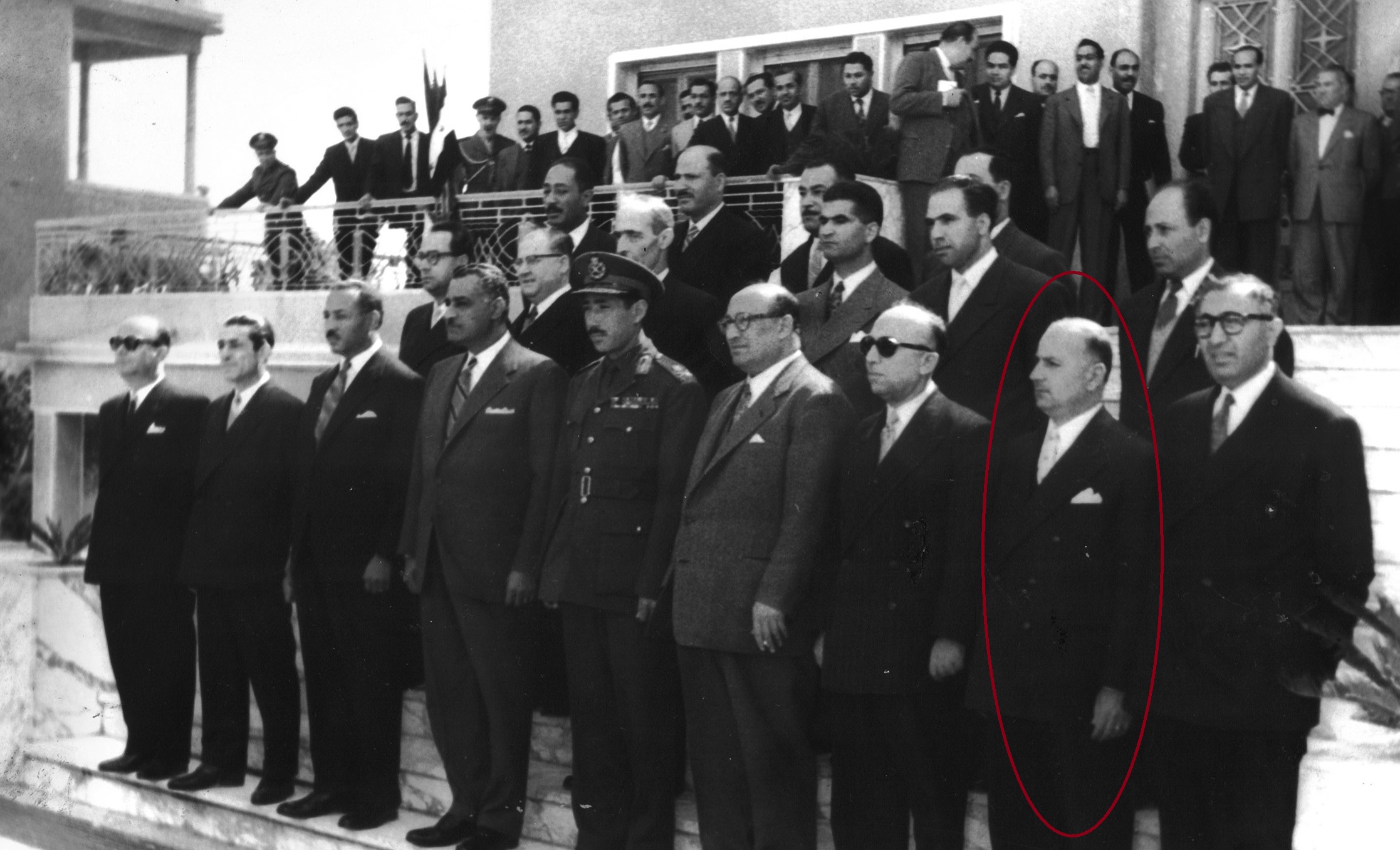
He was one of the firmest supporters of union between Syria and Egypt, and before it came he had helped conclude the 1955 military agreement between the two countries. When the union was proclaimed in February 1958, President Gamal Abdel Nasser chose him as Minister of Justice in its first government. In that post he refused to purge the judiciary under political pressure, despite the insistence of some of the military ministers, and more than once appealed in person to Nasser to spare men sentenced to death. He went on to serve as Minister of the Treasury and then as Minister of Planning in Cairo, where his family moved with him.
The secession of 28 September 1961 was a heavy blow to him. Back in Damascus he worked with fellow unionists to restore the union, in what became known as the United Arab Front, and paid for it: his car was blown up, and he was jailed along with some of his companions. When the secessionist regime fell on 8 March 1963 he briefly served as Minister of Finance, then left to teach at universities abroad.
He told the story of these years himself in two books, both published in full in this library: My Memoirs of the Syrian-Egyptian Union and Memoirs of the Secession.
Arrests
He was imprisoned twice and once placed under house arrest:
- After his coup in late November 1951, Adib al-Shishakli arrested him together with the members of Dr. Maarouf al-Dawalibi's government, although Homad was not part of it. He spent three months held in a wing of the military hospital at Mezzeh.
- Toward the end of al-Shishakli's rule he spent a month under house arrest in Aleppo.
- After the events of 18 July 1963 he was held for five months, from 20 July to the end of December, in administrative detention under martial law, during Salah al-Bitar's government, over political disputes about restoring the union with Egypt. "No charge was ever brought against me," he said, "and I was never sent before a court."
Some of his most honest poetry was written in prison, and a little of it appears below.
Conferences, missions and honors
Among the conferences he attended and the official missions he carried out:
- The Arab League conference in Cairo in 1955, at which Sudan was admitted to the League.
- The first United Nations congress on the prevention of crime, Geneva, autumn 1955, as head of the Syrian delegation.
- A visit to the Soviet Union, Czechoslovakia and Poland in summer 1955, as a member of the Syrian parliamentary delegation.
- The Arab Writers' Conference at Bloudan in 1956, which he chaired as Minister of Education of the host country.
- A special mission to the Vatican in 1956 concerning the question of Palestine.
- The meeting of the International Monetary Fund and the World Bank in Washington, autumn 1959, where he sat as Syria's governor at the World Bank by virtue of his ministerial office.
- The World Congress on Medical Law in Ghent, Belgium (August 1979), representing Kuwait University.
- The conference on Human Rights in Islam, Kuwait, 1982, where he chaired the fifth committee. It concluded that modern criminal procedure does not conflict with Islamic law, and called for a ban on special courts, such as state security and martial-law courts, and on any arrest not ordered by the judiciary.
- Seminars of the Arab Center for Security Studies and Training in Riyadh (1984) and Damascus, a seminar on Morocco at the Arab Club in Damascus (1994), and one on Constantine Zurayk held by the Friends of Damascus Society (2001).
He received three decorations: the Syrian Order of Merit of the Excellent Class in 1951, for his work on the constitution; the Order of the Egyptian Republic, First Class, conferred by President Gamal Abdel Nasser in recognition of his stand for Arab unity; and the Yugoslav state order, First Class, in 1960, for his part in strengthening relations between Syria and Yugoslavia.
His books
He wrote more than ten books on criminal law, several of them reprinted more than once. Among them:
- Political Crime (Dar al-Ma'arif, Lebanon, 1963), developed from his doctoral thesis, with forewords by two of his professors at the University of Paris. A revised and enlarged second edition appeared in 2001 as Political Crime in Comparative Legislation.
- Principles of Criminal Procedure (4th edition, Damascus, 1987), some 1,200 pages.
- A Detailed Commentary on the Penal Code: The General Part (Damascus, 1990), 1,152 pages.
- Advanced Studies in Comparative Criminal Jurisprudence (2nd edition, Damascus, 1987), 832 pages, which Dr. Hassan Sadiq al-Marsafawi, dean of the Faculty of Law at Alexandria University, called "a reference whose like is rarely found in Arabic."
- International Crime (Kuwait University, 1978), on crimes against peace, war crimes and crimes against humanity as they took legal shape at Nuremberg and Tokyo. "I know of no other Arabic book on the subject," he wrote.
- Two commentaries for Kuwait University, on Kuwaiti penal law and on Kuwaiti criminal procedure.
- Two books from his years in Morocco, on Moroccan criminal procedure and on the special part of Moroccan criminal law (Rabat, 1968).
Besides his law books he wrote memoirs that run to some three thousand pages, among them his Paris diary, "Memoirs of an Arab Student at the Sorbonne, 1939-1945," and his two books on the union and the secession, as well as a study of modern Syrian political history, Rushdi al-Kikhya: The Ascetic Leader and the People's Party. Those last three are published in full in this library, in the original Arabic and in English translation. He also wrote many articles for Syrian newspapers and journals and for the Kuwaiti magazines Alam al-Fikr and al-Arabi, and gave many public lectures, among them a talk on the new constitution at the People's Party hall in Damascus (1950), "Causation in Criminal Jurisprudence" (1984), "Professional Secrecy" (1986), "Political Asylum" (1993) and "The Development of Legal Thought on International Criminal Responsibility" (1998). The biographical note at the end of his memoirs of the union also lists works that were then going to press, among them "Humane Stances," "A Call to Simplify Arabic Grammar," "Contemporary Views on the Autonomy of Criminal Law" and "Contemporary Views on the Development of Islamic Thought."
The poet
He never published a collection. What survives is a set of pieces in his own hand, kept by his wife, from which Dr. Mahmoud Ahmad al-Sayyed published a selection. Since his schooldays under Sheikh al-Na'sani he had carried a great store of classical Arabic poetry in his head, and at Academy meetings he would bring out a fitting verse for every occasion, to the amazement of his colleagues. His own poems were written in prison, to his wife, and out of longing for home. The translations below are close renderings, not attempts at verse.
In Mezzeh prison, on 9 February 1952, he wrote a poem that runs through his life from Paris to the constitution and the ministry, and ends with his wife:
لكنَّ أكرمَ مِنةٍجاد الإله بها «أمل»
زوجي وأبهى غادةٍيزهو بها خزُّ الحلل
معنى الحياة وروحُهاوجنونُ شعري والغزل
Yet the most generous gift God granted me is Amal, my wife, the loveliest of women, who makes fine silk look proud; the meaning of life and its soul, the madness of my verse, and its love.
In prison again in 1963 he wrote "A Visiting Phantom," in which the image of his wife comes to him in his cell. It opens:
قضى الظلم أن أُلقى بغير جريرةٍبأعماق قبرٍ، لا أرى فيه آسيا
يضيق به صدري وتشتدُّ لوعتيوزنزانتي كالكهفِ تُدمي المآقيا
Injustice decreed that I, guilty of nothing, be thrown into the depths of a tomb with no one to comfort me. My chest grows tight there and my anguish deepens; my cell, like a cave, makes the eyes bleed.
Even there he kept faith in the union:
ليوم عزّك ما نلقاه من عَنَتٍزلفى إلى الله ذودًا عن مبادينا
وسوف يرجِعُ شملُ الدارِ ملتئمًاوتغمرُ الوحدةُ الكبرى مغانينا
What we suffer now we offer to God for your day of glory, in defense of our principles. The scattered house will be whole again, and the great union will flood our homelands.
From Rabat, on 10 April 1966:
في الشام روحي، وفيها قرتا بصريوفي الرباط أنيسي الكوكب الساري
My soul is in Damascus, and there the two delights of my eyes; in Rabat my only companion is the traveling star.
And when he decided to leave Kuwait in 1983:
كويتُ لا تعتبي إني على عتبِبيني وبينك موصول من النسبِ
وبي لجلّق تحنانٌ يؤرقنيشوقًا كنارِ الغضا مشبوبةَ اللهبِ
Kuwait, do not reproach me; I have my own reproach, and between you and me runs a bond of kinship. But I ache for Damascus with a longing that keeps me awake, burning like a fire of ghada wood.
He also wrote a poem addressed to France on the day it surrendered to Germany in 1940, a farewell to Paris, and an elegy for his colleague Dr. Abd al-Hayy Hijazi, dean of the Faculty of Law at Kuwait University.
His views
On teaching. He saw teaching as a national mission, not a job. Opening the school year in 1951 as Minister of Education, he told teachers: "You must love your profession from the bottom of your hearts, and be sure that it is the noblest of callings." He warned them to keep party politics out of the classroom: "Make your school a national paradise, not a partisan hell."
On Arabic and foreign languages. He wanted foreign languages taught seriously in secondary schools and universities, not so that students could pass an examination, but as working languages of study that would make up for the shortage of references in Arabic. He called for simpler rules of grammar and morphology and a single agreed spelling, and blamed "the stagnation that struck every part of our intellectual life" rather than the language itself, while insisting that reform must never touch "the language of our fathers, which has become the emblem of our dignity and the vessel of our culture and civilization." He proposed a single "unified Arab academy" to care for the language and develop it.
On poetry. He loved the old forms, the strong diction and tight craft of classical poetry, and admitted the influence of French Romantics such as Alfred de Musset, but he rejected verse that keeps neither meter nor rhyme: "at best, it is prose."
On unity and democracy. He believed in Arab unity from his youth, and wrote that "the best way to strangle political crime in its cradle is democratic government, power that changes hands through free elections, and a justice that gives every citizen a share of his country's wealth sufficient to his needs."
On religion. On the morning of Eid al-Fitr in Paris, after praying behind a Moroccan imam, he wrote that religion "is from God, and it is goodness and ease; it is the ignorant who make it complicated and load it with superstitions and innovations."
On knowledge and on women. He held that "knowledge is the common property of all mankind, and truth stands higher than feelings," defended fair-minded Orientalists against sweeping condemnation, and wrote that "the liberation of women is a religious, national and social necessity."
The Arabic Language Academy
On 24 November 1990 the Arabic Language Academy in Damascus elected him a full member, to the seat left vacant by the death of Dr. Shukri Faisal, and decree no. 205 of 27 May 1991 confirmed the appointment. At his reception on 16 October 1991, he spoke about his predecessor, as Academy custom requires, and said that he was no stranger to the world of letters, in which he had lived for a time before the rigor of the law carried him away.
He served on the committees for manuscripts and the revival of heritage, for the journal and publications, and for the foundations of the language. He lectured at the Academy on political asylum (1993) and on international criminal responsibility (1998), and spoke on simplifying Arabic grammar at the celebration of the Academy's seventy-fifth anniversary. His colleague Dr. Ihsan al-Nass recalled that he often volunteered for extra work, and that when he heard a view contrary to his own and found it right, he accepted it without hesitation.
Family
In 1946 he married Amal al-Kourani, daughter of Ahmad Subhi al-Kourani of Aleppo, who had completed secondary school. In Paris he had made up his mind not to marry a foreigner, and on 28 April 1946 he wrote that Paris, for all its charms, now meant nothing to him:
باريسُ أُعطيت خيرًا من غوانيكفي جنة لا تحاكيها روابيكِ
Paris, I have been given something finer than your beauties, in a garden your hills cannot rival.
They had a daughter and a son: Maysa, born in 1948, who took a degree in French literature at Damascus University, and Ghassan, born in 1952, an electrical engineer in electronics, also from Damascus University. Friends called Homad "Abu Ghassan," the father of Ghassan. On Ghassan's wedding day, 25 February 1979, he wrote:
غسانُ يا مهجتي يا فلذةَ الكبدِيا متعةَ النفسِ في دنياي يا ولدي
Ghassan, my heart's blood, part of my very self, joy of my soul in this world, my son.
His brother, the lawyer Dr. As'ad Homad, described his home life as "easy and gentle, ruled by love, affection and respect, and free of domination and of imposing one's opinions." He listened closely to whoever was speaking, As'ad said, and worked without tiring and without complaint.
Death and memorial
Dr. AbdulWahab Homad died in early 2002, after an illness. He had kept working at the Academy and on its committees until the illness took hold.
On the evening of Wednesday 13 March 2002, forty days after his death, the Arabic Language Academy in Damascus held a memorial for him in the lecture hall of the al-Assad National Library. The speakers were the Academy's president, Dr. Shaker al-Fahham; the Minister of Education at the time, Dr. Mahmoud al-Sayyed; the dean of the Faculty of Law, Dr. Abboud al-Sarraj; the former Minister of Justice and former head of the Bar, Mazhar al-Anbari; the Academy's vice president, Dr. Ihsan al-Nass; and, for the family, his brother Dr. As'ad Homad. Al-Anbari ended his tribute with the words: "In the faded, sickly fabric of life, AbdulWahab Homad was the purple thread." May God have mercy on him.
Sources
This account draws on Dr. AbdulWahab Homad (1915-2002), by Dr. Mahmoud Ahmad al-Sayyed (Damascus: Arabic Language Academy, 2013), which gathers his life, his works, a selection of his poems and the speeches given at his memorial, and on Dr. Homad's memoirs; all of them are published in full in this library. The family thanks Dr. Mahmoud Ahmad al-Sayyed, who gathered this record of his life out of loyalty and affection.