Before These Memoirs - Part 25: Wadih Saydawi's Union of Dynamite and Human Remains Article Calling the Five Haganah Officers
Monday the 23rd
Today is the "anniversary" of Egypt's Free Officers. On this day, Abdel Nasser and his own comrades led the victorious battalions and put an end to the corrupt monarchy imposed on the country, establishing a republic headed, for the first time in the whole history of the Nile Valley since the fall of the last dynasty of the ancient Pharaohs, by a true Egyptian Arab.
Abdel Nasser delivered his own traditional speech for this occasion, speaking of Egypt's progress in industry and agriculture, once its own farmers had been freed from the yoke of feudal exploitation.
But he did not forget us either, launching a forceful campaign against the Syrian regime and its reactionary rule. He affirmed that were he asked to attempt the union experiment once more, bitter as the secession had been, he would not hesitate to do so, out of reverence for the higher interest of the beloved Arab nation.
He said the honorable unionists of Syria sat in "the secession's own prisons," subjected there to the harshest suffering.
He wounded the feelings of the secessionist regime's own men when he referred to Syria as "the Northern Region," and gave the Syrian people and the Syrian army the lion's share of his own praise and tribute.
We met with a government minister this evening. He was genuinely afraid for his own life.
We asked him the reason for this fear, and he said he had serious information about Nasserist plots, and believed a series of bombings and assassinations was about to strike Syria, and that he himself was quite likely to be one of their victims.
We assured him that the unionist path was one of persuasion, resting on meeting argument with argument, and working to establish union through the full consent of every side, with no place at all in it for violence or coercion, and that he could therefore "sleep with an easy mind."
It appears his own "information" was drawn straight from the columns of the corrupt press, which greets us morning and evening with talk "of a Nasserist plot to burn down Damascus" and "reliable arrangements for the assassination of certain secessionist figures," describing us as "paid Nasserist agents" and "Abdel Nasser's own orphans," fully aware all the while that these are lies, spread only to sow panic in the country and boost sales of their own poorly circulating newspapers.
Our friend Mr. Abdel Hamid Duwaidri, deputy for Idlib, told us he had been summoned by intelligence and interrogated "over his own distribution of Nasserist leaflets," which he denied any knowledge of. I know this accusation to be false, since he acts only on our own collective judgment, and we have never issued a single leaflet that did not bear our own signatures. But this is simply a campaign of terror.
Our friend the minister, whom we had been sitting with, confessed to us that he was "deeply afraid for his own life, and that Abdel Nasser would never leave him alive for his own children to inherit." He assured us that his own intelligence apparatus had confirmed to him that a coup would come sooner than the men in power expected, but that the Saudis, the Jordanians, the Iraqis, and the British would resist it, even by armed force if necessary.
Nor did he forget, God preserve him, to reserve some biting words for his own friend the President of the Republic, describing him as weak and indecisive. But if he were to leave power, who would succeed him? The army, in his view, could never accept Akram al-Hourani at the head of the state, nor Maarouf al-Dawalibi, who had promised, as he put it, to issue a statement clarifying the circumstances of the seventy thousand dinars he had taken from the Iraqis in 1954, yet never did. And so "the whole era" now lay dying, with not so much as a glimmer of light on the horizon to save the country from the state it had fallen into.
What reached our ears, in these very days, was that it was the secret services themselves suggesting these unsettling reports be spread, since they were preparing criminal acts of their own, possibly the assassination of certain loyalists of the regime, or of its opponents, in order to impose a reign of terror on the country.
We therefore decided to exercise caution, and to refrain from making any public statement, until matters became clearer.
Tuesday the 24th
A military court has convened in Damascus, presided over by the civilian judge Ahmad al-Rashed, to try "the Aleppo crime," whose events took place on 2 April and the days following it, that is, immediately after the 28 March coup and in the wake of the Homs military conference and the exile of al-Nahlawi and his officers.
Judge Ahmad al-Rashed had been a fellow student of mine at "the Law Institute in Damascus" in 1937, and upon graduating had joined the judiciary, rising steadily through its ranks until he became one of its finest and most respected members. I never saw him again after leaving the Law Institute for Paris, not even during my own term as Minister of Justice in 1958.
Yet I followed news of him closely, when I decided to study the state of the judiciary and "purify" it, as my fellow ministers had asked of me. And the news of him was always good, given the impartiality and integrity he was known for.
I judged he would conduct the trial with firmness and resolve, fearing no one and favoring no side. The first thing he did was oppose accepting private civil plaintiffs as parties to the public case before his own court. But the two military judges outvoted him, and voted to accept it, and a flood of lawyers descended on the court, said by the newspapers to number as many as seventy.
No one among us is unaware that accepting private civil plaintiffs is simply not permitted before exceptional courts of this kind.
The first misstep the court committed, then, was opening the door to people who had come merely to make a spectacle and cause mischief, eager to see their own names printed in the newspapers.
In fairness, when I reviewed their names, I found them to be lawyers of the "third rank." They had rushed forward to "defend" the dead, whom we ourselves are the first to mourn. But what struck me as odd was one lawyer the newspapers named as As'ad al-Ghourani. I cannot say for certain whether this was the brilliant Aleppan lawyer As'ad al-Kourani. If it truly was this well-known lawyer, then he must have appeared as one of the secessionist faces, repaying the debt of his own success in the elections on Dr. Maarouf al-Dawalibi's own list, and satisfying the capitalist class that had promoted his own victory, not out of any legal conviction, but simply as an act of advocacy sanctioned by the code of legal procedure.
The newspapers described this trial as proceeding like a farce, with the accused laughing and joking among themselves, and clashes breaking out between the prosecution's and the defense's own lawyers. They quoted the public prosecutor, Major al-Haffar, describing the accused as "standing before the court in humiliation and abject misery."
This directly contradicts the newspapers' own claim that they were laughing and joking.
Wednesday the 25th
Every single day, the regime "discovers" a new "Nasserist sabotage ring."
I doubt I will bother writing on this subject again, since I have grown as weary of it as everyone else has. But it seems the sincere patriot Ahmad Assa, owner of Al-Sada al-Aam, has not grown weary of it at all, this same man who had once been an extreme leftist, and ended up a drifter writing about the miracles of the oil-rich desert and about Hassan II of Morocco.
He wrote of "a Nasserist plot to assassinate certain political figures," saying the security authorities "had arrested members of a ring accused of taking money and acquiring weapons from Nasserist sources."
He said security forces had killed five infiltrators.
Yet the government moved quickly to deny this, saying "our own artillery" had shot down an aircraft of unknown nationality over Latakia. The government denied this second story as well.
It is as though these liars had memorized the creed of the suicide Goebbels, propaganda minister to German Chancellor Hitler, who used to say: "Lie, and keep lying, for something is bound to stick in people's minds."
This newspaper's own editorial contained an incitement bordering on an open call to "kill the Nasserists," achieved "by pushing the people, under the influence of a wave of anger, against the Nasserist elements," and should anything of the kind happen, the reaction would end in blind, indiscriminate strife.
This is exactly what the current Minister of Information, Dr. Abdel Salam al-Ujaili, himself said to the press. Aleppo's security authorities claimed to have uncovered nests of sabotage and a ring "terrorizing" the city's own security, distributing secret leaflets among the people urging resistance to the secession. They named three people, whom I quote here:
Hassan Qabbani, an employee at the transport office.
Muhammad al-Yasir, an usher at the Directorate of Economy.
Jumaa Batata, a hired barber's assistant.
These, then, are Abdel Nasser's own agents in Syria, whom he "fed with money and equipment" to resist the secession and set off the bombs that have begun shaking Aleppo and other Syrian cities alike.
It is true that the people hound the secessionists, tightening the noose around them simply to terrorize and unsettle them. Some people arriving from Aleppo told me that the secessionists' own daughters no longer dare walk the streets, after passersby "spat" on one such "clothed yet naked" young woman, striking fear into every girl of her own class. As chance would have it, her own father had become one of the fiercest enemies of the union, after having once sung its praises in its own day.
A single "spit" in their faces was enough to leave them "fearing for their own fate at the hands of terrorists." "And indeed, the frailest of houses is the spider's web, if only they knew."
And if what Mr. Rashad Barmada told us is true, that the government is breathing its last breaths, and that a coup has become imminent, then the restraint we have bound ourselves to, never inciting the workers or pushing them into bloody confrontations with the security forces, finds its own logical and humane justification in these newly emerging circumstances.
We, the Front's leadership, met today, and decided not to answer our friends the "Arab Nationalists'" request that we sign a petition bearing 150 names, to be published on the radio and in the newspapers, in the hope of stirring "some sense of honor" in the hearts of the armed forces, wary and fearful as they are for their own survival.
Our own view was that the army needed reassurance about the fate of its own officers, and that it would therefore be wrong for it to feel we stood in open confrontation with it, declaring outright hostility, lest we provoke it into some open action against the unionists and against union itself.
Especially since we work in open politics, on openly declared principles.
We are not a party that operates in secret, the way the Communist Party does.
Thursday the 26th
A new party law, drafted by the government, was published today in the local newspapers. What caught my attention in it was that it allows civil servants and students to belong to political parties, provided they do not engage in party activity within government offices or educational institutions.
I found it strange that President al-Qudsi would accept provisions like these, he who, along with his own brothers, had once encouraged me to keep politics out of every one of these institutions.
I note, for the record, that I had once submitted a draft law to the chamber of deputies, in 1955, banning any political activity whatsoever among students and teachers. A great many deputies opposed this bill at the time, on the grounds that general conditions then did not allow for it.
Have al-Qudsi, al-Dawalibi, Mustafa al-Zarqa, and their own supporters in power become more progressive, then, than al-Hourani's own followers?
A director at the Central Bank announced today that the bank had decided to devalue the Syrian pound relative to its own true value in foreign exchange.
Dr. Yasser al-Bitar explained that this measure had become necessary after the country endured four consecutive years of drought, which had taken its own toll on the pound's financial strength.
It appeared the bank had acted soundly in this, so that the pound's value might remain consistent both at home and in neighboring markets.
President Abdel Nasser delivered a new speech in Alexandria, as was his own custom every year.
It has become one of the Egyptian revolution's own traditions to honor the University of Alexandria with an annual speech, since it was the first university to openly and publicly declare its support for the Free Officers' movement, strengthening their own resolve, a courageous and noble stance they have never forgotten.
The President's speech today carried the gravest weight, both for us and for the region as a whole. He said that he had declared, this past September (1961), that he would let the Syrian people decide its own fate for itself, but that events had proven this had never truly come to pass, given the domination of a tyrannical faction over its own destiny. He had therefore decided not to give up the very being of the United Arab Republic (a name he had never formally abolished in the first place), nor its own Northern Region, since it could never be right to leave a band of criminals free to throw intellectuals and unionists into the depths of prison, and that he would no longer accept workers being subjected to the harshest suffering, merely for being unionists and demanding that the gains the union had won for them not be taken away.
He closed his speech by declaring that he would stand beside the oppressed Syrian people to the very last drop of his own blood.
When we studied this speech among ourselves, we concluded that if the President were acting according to some carefully studied plan, then he had, without doubt, shaken the nerves of Syria's own rulers, and stirred real panic in their hearts, men who already lived in constant dread of any move against them, in the dead of night.
But if he was speaking merely out of emotional impulse, whether personal or national, then the consequences of this speech for us would be severe.
It seemed certain we would become fresh fuel for a fierce new wave of official statements and security actions, foremost among them from its own frenzied, bloodthirsty commander, who feels along his own neck for signs of his own safety, searching for reassurance.
Friday the 27th
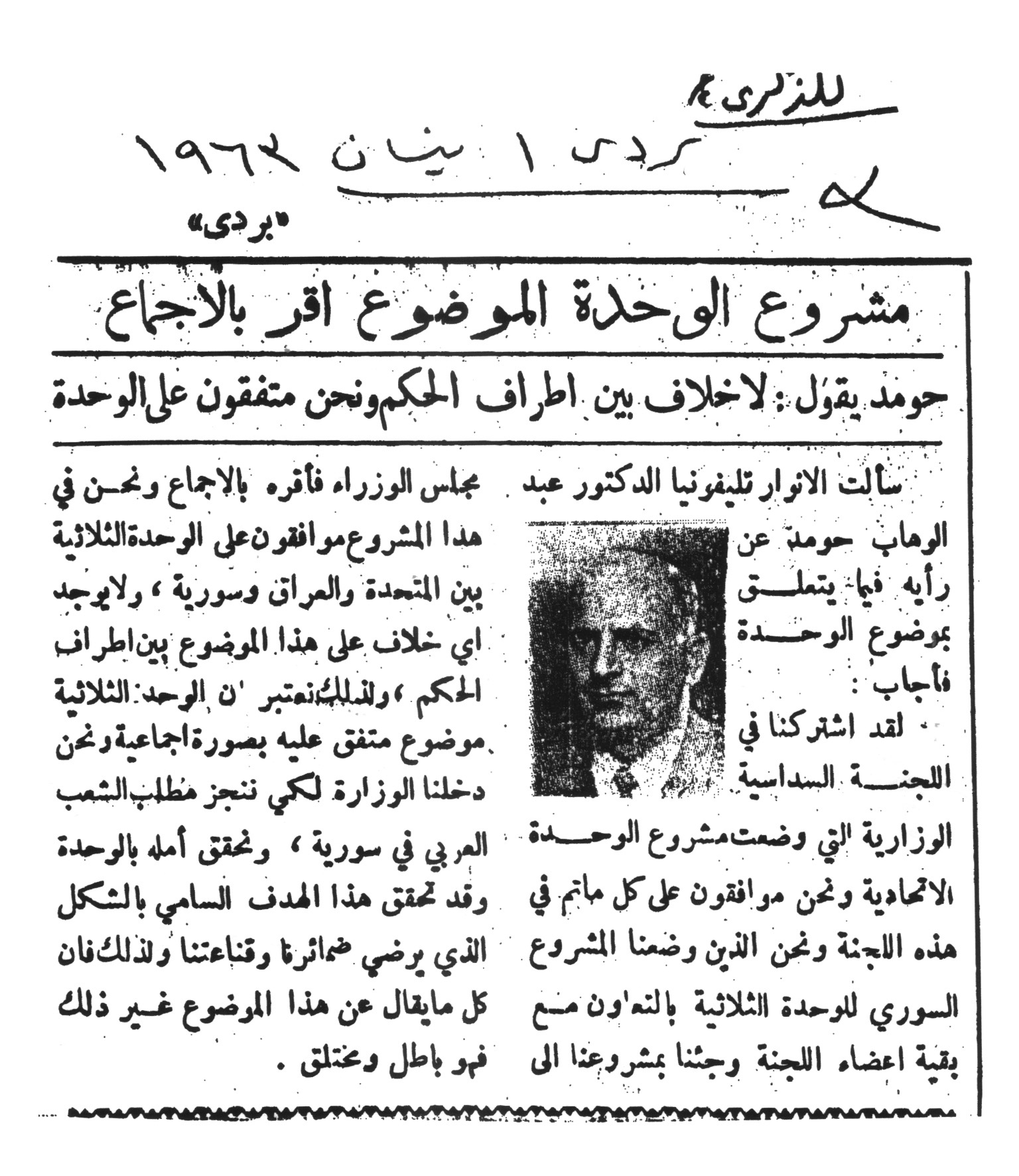
Just as we anticipated yesterday, the attack against us began, launched through curses hurled at Abdel Nasser. Among its crudest opening shots was what the zealous journalist Wadih Saydawi wrote in the newspaper Al-Nasr, a man whose own journalistic conduct had long since left the realm of politics for the ugly climate secretly fed by malicious grudges.
He wrote in today's issue:
That the Nasserist Five had now become four, meaning, without doubt, Mr. Ali Bouzo's own withdrawal, since he no longer cared to venture far from his own neighborhood (al-Akrad), where he found protection and warmth, a baseless fabrication.
He explained the "fifth man's" own withdrawal by claiming he had not received his own share of "the spoils and the plunder." This time, he also attacked the unionist Baath Party alongside us.
He chose a repellent title for his article: "The Union of Dynamite and Human Remains."
Here is one of its passages:
"Ask the Haganah officers Homad, Bouzo, al-Husami, and the sinner (this is how the article referred to Mr. Nihad al-Qasim), and the drunken vanguard of Aflaq and al-Bitar, how this astonishing harmony in method, in malice, and in thirst for the innocent blood of Arabs comes about.
Answer, and may your daily bread of pounds come from God above."
It is a genuine misfortune that these paid pens, whether working for domestic or foreign interests, should sink to such a base level in a political contest over so honorable a subject as union. We have no newspaper of our own at our disposal to answer these obscenities.
Nor has it ever been our own method to stir up hatreds of this kind, for we have declared, without hesitation or ambiguity, that we want a union resting on mutual understanding between the Egyptian and Syrian peoples, within a framework of mutual consent, never one achieved through force or violence, for such a union would be an imposed one, and an imposed union is a union already condemned to die.
Making matters worse still, Voice of the Arabs radio announcer Ahmad Said kept up a relentless campaign attacking Ahmad Abdel Karim, who had served as a minister during the union era. I had heard he was leaning back toward a unionist direction, but the continued assault on him only embarrassed him so deeply that it drove him away entirely.
Photographs
Photographs accompanying this section, from the family archive. Individual captions are not shown here because the original extraction's photo-to-caption pairing could not be reliably verified.