Chapter 2: The Upbringing of Rushdi al-Kikhya: Family, Schooling and Character
The prevailing social pattern in Aleppo was that its people formed two classes:
a popular class, the larger in number and in output, working in industry, trade and agriculture; and the class of the notables, the sons of the prominent families, who lived from day to day on the varied produce that their agricultural "estates" yielded, especially wheat and olives.
The sons of this class were in direct contact with the official authorities, because they held influential posts in the machinery of the state, whether the positions were high or modest.. In every case they gave their holders a good salary and social standing.
In most cases these officials had little schooling.. and very few of them held a higher degree. My mind goes back to our teachers at the "Maktab Sultani", which brought together the best of the educators, and of the educated too.
Our headmaster, Tawfiq al-Jabiri, God's mercy be upon him, was one of the few who had studied at the "Royal College of Administration in Istanbul", and the running of the school was entrusted to him.
I would like to digress a little, to ask God's mercy on him for the good he did our whole generation, all of us who studied at or graduated from this school of his.
He was a man of presence and standing, with a strong sense of his own dignity and of the weight of his responsibilities. He stood up to the French officials of the ruling Mandate in order to protect the Arab national spirit in his school, and to protect its students, who used to go out in mass demonstrations in support of the men of the National Bloc.
From the heart of one of these good families Rushdi al-Kikhya was born, in 1899 AD according to the official records, or in 1900 according to his friends, and he grew up within the framework of its rules of manners and learning and its traditions. The First World War overtook him when he was fourteen years old, and his schooling was disrupted.[1]
He worked in farming, but alongside that work he never stopped studying, and he read every book he could lay his hands on, so that he gave himself a good education.[2]
On the subject of Rushdi al-Kikhya's upbringing I draw on what his boyhood companion, Mr. Tawfiq al-Muyassar, said. He said the following:
"I came to know the deceased in 1910.
"He was about ten years old at the time.
"We were neighbors in the Farafira quarter,[3] and my father was a friend of his father, Mr. Abd al-Qadir. That year our families sent us to Beirut to study as boarders at the 'Islamic College'. The owner of this school was Sheikh Ahmad Abbas al-Azhari, and it was also known as the 'School of Sheikh Abbas'. It stood in the Burj Abi Haydar quarter. This school drew the attention of well-off families from all over the Arab countries, because of its fame and the reputation of its owner. Its students were therefore a mixture of the sons of those countries, so much so that it was said to have been the fertile soil for the first seed in the field of Arab and Islamic unity. Many of its graduates became leading figures in society and politics in the region.
"In 1912 the Italians shelled Beirut from their fleet, and we went back to our home city of Aleppo. There we enrolled together in a school the Germans had founded in the Jdayde quarter. Its students, too, came from wealthy families. Abd al-Aziz al-Hallaj was one of our schoolfellows.[4]
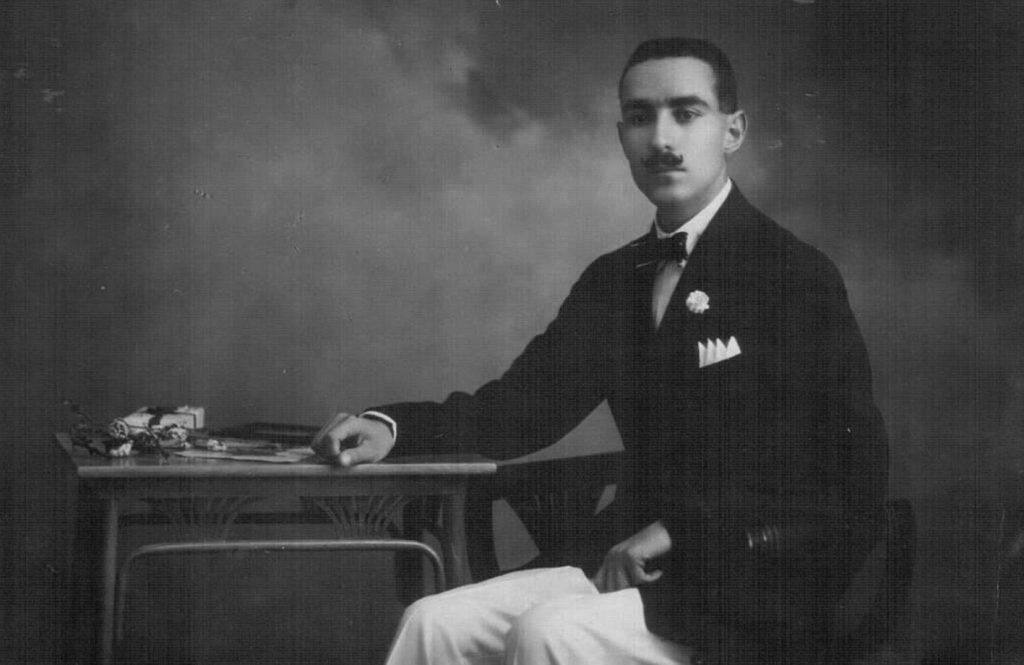
"After our lessons we used to play games in the Kikhya 'qonaq' (the great house), and some of the boys of the Sayyaf family played with us. We were not allowed to mix with any other boys of the quarter.
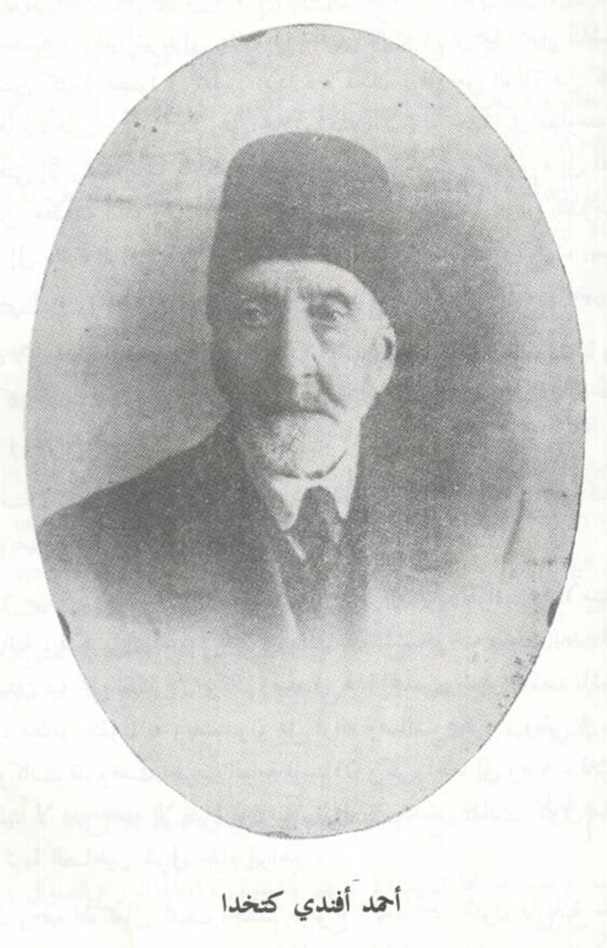
"Rushdi al-Kikhya was brought up strictly at home, especially by his mother, Halima, who was his father's cousin. She watched over him and kept an eye on his friendships with other boys. This close supervision may have been what kept him from having any hobby as a child. Even when he grew up and became a young man, he remained almost cut off from people apart from this small group of neighbors' sons, and so he formed a picture of the outside world and its people that was entirely different from what he met once he entered working life. His paternal grandfather, Ahmad Effendi, was one of the leading notables of Aleppo and one of its wealthy men, and his house in Farafira was grand and spacious. There he received his friends as his guests, and also the senior Ottoman statesmen who came to Aleppo or passed through it, especially as he was a member of the Ottoman Senate in Istanbul."
The author of Al-Munjid, in its section of biographies of famous people, gives this entry for him:
"Katkhuda is a Persian word meaning master, which later became Kikhya and means custodian in Turkish. Ahmad Katkhuda was born in Aleppo in 1838 and died in 1919. He was a member of the Provincial Administrative Council and one of those who defended the rights of justice against the governor Djemal Pasha."
Sheikh Raghib al-Tabbakh wrote at greater length on the Kikhya family in his book "A'lam al-Nubala' bi-Tarikh Halab al-Shahba'". From this account we learn that this Ahmad Effendi had four sons: Muhammad, Arif, and Abd al-Qadir, the father of Rushdi and his brother Nadim; the fourth died young.
"Ahmad Effendi was a man of some wealth, but he squandered his cash fortune on extraordinary spending and sank into heavy debts, which his sister Asoum (Asma) helped to make heavier. After his father's death Abd al-Qadir was forced to sell part of the inherited real estate to pay off his father's debts. Once the family was entirely clear of all debt, Abd al-Qadir (Rushdi's father) left Aleppo for good, for family and health reasons, and lived in the (Lebanese) city of Sidon until death came to him there." (End of al-Tabbakh's words.)
His brother Nadim took his father's place in managing his own property and that of his brother Rushdi, who felt deep inside himself that fate was preparing him to play a major role in the life of his country, something other than overseeing the picking and pressing of olives and settling accounts with the peasants.. the sharecroppers.
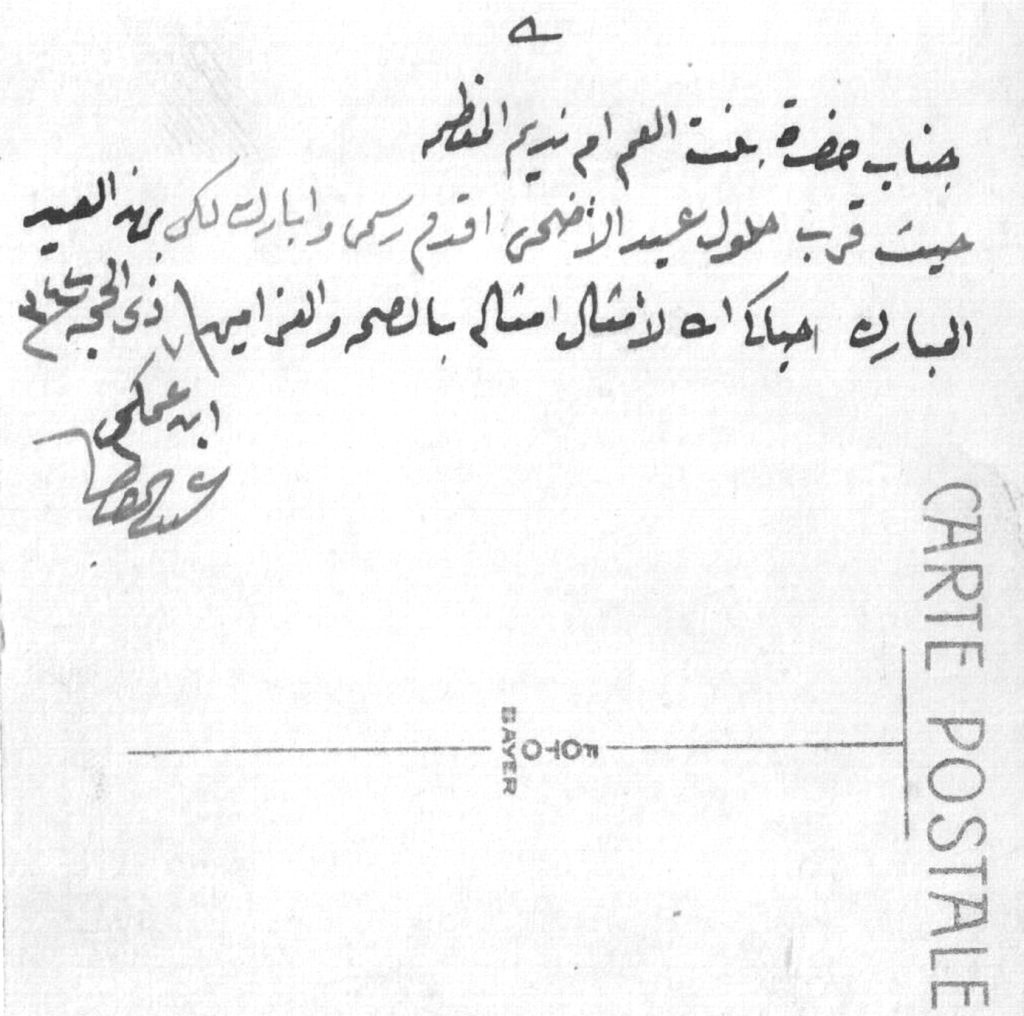
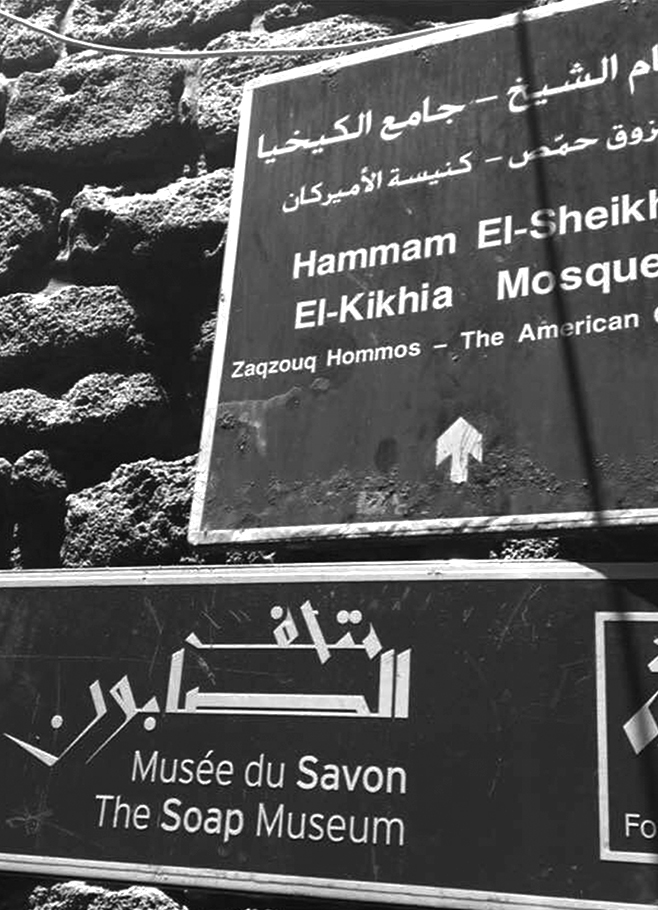
Nadim was good to himself and to his brother. He threw himself into the work with unflagging energy and built up his own property and his brother's, which they held jointly, using the surplus of the harvest to enlarge it, until it became truly considerable and spared Rushdi the need to take up any commercial, industrial or salaried work. This was an unusual course, because the sons of the class he belonged to sought a post in the government machinery, since it carried a fixed monthly salary and gave its holders extra standing, which they enjoyed when members of the public stood before them holding their papers and presenting them for signature in a pleading manner, or set out their complaints and needs, which the officials condescended to hear.. Illiterate men were numerous in the machinery of the state. They exploited the ignorance of the people, which the state itself took care to keep alive, in order to shore up their own standing.
When the sons of the people had become educated and come back from foreign universities, the train had already left behind this philosophy of milking office for the family. That was an ugly stain that never touched the brow of Rushdi al-Kikhya. He and his brother kept well away from the slippery paths of greed and the scramble for advantage, and all their lives they were content with the belief, settled deep in them, that true standing lies not in the prestige of power but in building good relations with people.
Rushdi never married.. He remained a bachelor until God chose to take him to Himself, and he went to Him free of the troubles, worries and problems of family life.
I learned that he had asked for the hand of a girl from the Mudarris family of Aleppo, but his mother stood in the way of the marriage and prevented it from going ahead. After that he asked for the hand of a girl from the Jabiri family, and the engagement fell through, perhaps because of an old coolness between the two families.. It seems that from that time on he made a final decision to remain a bachelor all his life.. and he kept the promise he had made to himself.
I was close to him for many long years, and I never saw a stain on his conduct.
All his friends and his colleagues in political life, and outside it, are agreed on this. We never once saw him drink wine; in fact he hated it and shunned it.
We never heard that he gambled.. Even tobacco he took only now and then, and only to "puff" on it.. either to be polite to a visitor or to pass the time.. But he was never put out by anyone who took a drink or smoked a cigarette.. especially on official occasions, which he very much disliked, such as receptions at foreign embassies or receptions given by the Syrian government.. He was, God have mercy on him, truly religious, but he was not a fanatic. We knew that he was repelled by the gamblers among his friends, even when they hid it, and did not trust their honesty or integrity. This kept one of his companions from being given a sensitive ministry, because he was known to gamble.. And he was right to dislike the gambler, because a man who loses cannot be trusted with his own dignity and reputation, let alone the dignity and the money of the state.
Honesty obliges me to keep a certain reserve, because the deceased was very secretive about his private and public relationships. But because we were with him so constantly, by day and by night, we were all agreed that he had no private life in the sense the term has these days. If he did have such a private life, it was kept entirely hidden, known only to God and to him. As far as we knew and heard, though, he was upright in his intentions, plainly honest and clean in his conduct, and no one ever branded him with misconduct holding any evidence that could rise even to the level of the ordinary circumstantial evidence of everyday dealings.
How pleasant his company was, how clear his spirit and how clean his tongue!.. I used to join his circle at the party headquarters in Damascus or Aleppo, or in the lobby of the "Orient Palace" hotel in Damascus, or at the Sabil café in Aleppo, or on foot as we walked for pleasure and exercise, because we took no exercise of any kind other than walking, by which we gave our bodies their due.
It was always his habit to rise to his feet to welcome any visitor to his circle, seat him in the place of honor and ask him what he would like to drink.. while he himself always remained the center, the focus of every eye and heart, his standing in no way lowered by where he sat. The books of our heritage tell that Imam Ahmad ibn Hanbal once came into a gathering of his companions and sat at the lowest end of the room. They were dismayed and begged him to sit at the head of the gathering, and he said to them: Wherever I am, that is the head.
His company was at its most pleasant when he was in good spirits. His eyes would shine with a light that put people at ease and reflected the purity of his good nature, and the smile never left his lips. In such a "state", as the Sufis say, his hand would reach for the cigarette box and take one out, light it and start puffing on it.. If the gathering was a serious one, a boundless gravity came over everyone present.. they would drop every other subject entirely.. and give themselves wholly to the matter under discussion.
He kept open house every morning at his home in Farafira, receiving anyone who wished to visit him. His visitors were usually many, from Aleppo and elsewhere.
Besides this gathering at home, in summer he used to sit on the terrace of the Baron Hotel, the finest hotel in Aleppo in those days, and in winter at the Ramses Hotel.
These two gatherings were small and reserved for the friends he felt closest to.
He was, God have mercy on him, eager to know the news of his friends, not out of curiosity or prying, but so that he would know their worth and could put the dots on the letters when needed. He never hesitated to put his finger on the seat of the trouble if he found in one of them a "boil" that needed the lancet.
He kept up his morning gatherings even in his exile in Beirut and in Limassol (Cyprus), after he left the country in 1967.
At meetings of the party bureau, especially when we were discussing domestic and international political questions, his habit was to stay silent and listen to every speaker who wanted to have his say.. however far the talk might wander.. I admit that I often lost patience with some of the discussions and digressions, especially those of the pompous speakers who think they hold the secrets of the unseen and the keys to every problem, but never offer anything useful.. He, on the other hand, was steady of heart and relaxed of face, listening with every part of him, or seeming to, his eyes fixed on the speaker, attentive to him with courtesy and evident interest, as though he were learning from him things he had not known.. When at last he took the floor, he summed up the differing opinions and gave his own view.. and often his word settled the matter.. But if disagreement remained among the members, he put the disputed question to a vote.. and the side of the majority was the one adopted.. and the first to abide by it was the president himself.. The right to express an opinion and defend it was subject to no restrictions.. for we were democrats by nature, hating domination and holding fast to freedom of opinion, and he was in the front rank of all this.
For example, the question of women's right to stand for seats in parliament came before the Chamber of Deputies. I was known as a warm defender of this right. But when we discussed the matter in the party bureau, the majority view was that the time was still too early.. and that advanced countries of that day, such as Switzerland, did not grant women this right. It was decided to vote against the proposal in the Chamber.. And of course I stood with my party.. in a state of mind no one would envy, and the "progressive" papers attacked me the next day.. and they were right to blame me.
This mistake was later corrected, and the doors of parliament were opened to women with the proclamation of the union between Syria and Egypt.
Rushdi was counted among those whom God had blessed with good looks. He dressed elegantly and had a fine figure. But what God gave him above many other people was his great courtesy, his gracious character and his clean tongue.. I bear witness that I never once heard him speak ill of anyone behind his back, or mention an absent person in a crude or vulgar word; even his opponents enjoyed this protection. We used to look on some politicians with less than respect, and found nothing in them to justify our trusting them.. Rushdi would content himself with putting a "banana peel" in the path of such people, and they would slip and fall on their faces.. If the matter called for more than that, he would take the stand of a man who neither maneuvers nor plays games.. And when the boiling anger of those he had brought down in the race for power was turned on him, he met them with pride and calm, and never stooped to their level. Never once did he let a political debate sink to the level of personal abuse. This statement takes on its full weight amid the deep divisions between the political currents of those days, caused by the Cold War on the stage of international politics.
I should point out that I am writing this book in 2001 about public events that began more than fifty years ago. The division over foreign policy and economic doctrine appeared when two hostile camps formed in the world: a camp that raised the banner of democracy, led by the United States together with the colonial powers long practiced in the art of exploiting peoples, and the camp of socialism led by the Soviet Union. Hot and bloody wars broke out between the two camps in many countries, such as Korea, Vietnam and Afghanistan, and they were also fighting a "cold war" aimed at frightening the enemy, gathering supporters and setting up military alliances. America in particular worked to encircle its enemy the Soviet Union with a long belt of alliances, starting with the North Atlantic Treaty, passing through the Baghdad Pact and ending with the iron ring that took in the countries of Southeast Asia.. In this it used every means of temptation and intimidation, on the principle that "whoever is not with us is against us". If it could not bend a country to its will because that country raised the banner of neutrality between the two camps, especially if it lay within that hellish chain, then America and its allies, even the Arabs among them, would create every kind of trouble for it, from economic pressure and denial of arms to the use of armed force.
In our own country there were violent internal struggles between the supporters of the right, backed by America, and the supporters of the extreme left, who had the support of the Soviet Union. The hardliners on each side of the confrontation called their opponents "traitors", "agents", "lackeys" and "groveling capitulators".
Between these two sides, however, there was a great majority that did not believe in the use of this mutual hostility and saw it as dangerous and harmful to the national interest.. It wanted the country to stay, truly and sincerely, out of the reach of foreign influence and to have balanced relations with the various outside currents. The policy of the People's Party stood with this broad middle.
But that was not always open to it, because a pressure group within the armed forces would win out in a struggle that went on beneath the surface, and sometimes above it, so that the scale tipped and the balance was upset. Certainly the series of coups that took place in our country was one form of this struggle with foreign roots. which was often backed by outside moves, examples of which are the Turkish troop concentrations on the Syrian border, the Tripartite Aggression against Egypt, and the inter-Arab wars..
America was always in the front line of our wars with Israel, supplying it with money and weapons and even with men, then pushing it into a "punitive campaign" to impose its policy on the region.
Many Western countries stood beside it openly or in secret and any reading of these chapters that does not take into account the atmosphere that surrounded their events remains a truncated reading and does not give the true picture of the stands of quiet courage.
It remains for me to answer a question that is not without its sensitivity, one that has often been put to me in the past and in recent times, namely: How did Rushdi al-Kikhya come to lead this great party, among whose members were a number of university professors and holders of the highest degrees from the oldest universities, when he held no academic qualification?.. My answer was that the circumstances of his upbringing and the cultural state of the country in his boyhood and youth were not in his favor. In his family's eyes he was an "agha" by birth, whose wealth and standing spared him the need for study and diplomas.. But when he began to take an interest in politics he opened his eyes to life and began to learn from it and to teach himself.. so he is one of its brilliant graduates.. He gained a good grasp of the economic currents of the time, and came to know the hidden workings of international politics.. and he knew truly where his country's interest lay, and stood where he ought to stand: a moderate leader, sharp of sight and deep of insight. He had his equals among the leaders of those days, first among them our revered teacher, Speaker of Parliament and our brilliant representative at the United Nations, Faris al-Khouri. He too was one of the group who taught themselves, whom the French call autodidactes. Among these brilliant people who did not study at university yet played a notable part in the politics of their countries were Winston Churchill, Prime Minister of Britain, the American Benjamin Franklin,[5] and John Major, Britain's Conservative Prime Minister in the 1990s. And so were most of the great leaders of the socialist world, which has now broken apart.
It is no secret that there were two wings in the People's Party, agreeing on some things and differing on others.. That is the nature of parties that do not put revolution and coups in their programs.. The remarkable thing is that each of the two wings regarded Rushdi al-Kikhya as one of its own.. He was the counterweight of the steelyard, always standing where balance and the right solutions were to be found.
A few days ago Dr. Shaker al-Fahham, President of the Arabic Language Academy, which honored me by electing me a member, and one of the prominent members of the Arab Socialist Baath Party, visited me at home, accompanied by our friend Dr. Abd al-Halim Suwaydan, a member of the Academy.[6] We talked about the Homs meeting that took place after the coup against Adib al-Shishakli in 1954. Among the things Dr. al-Fahham said was this: I attended that meeting representing the Baath Party, because the party's leaders were in exile at the time, and I listened to the representatives of the parties and the politicians present on the question of how to rescue the country from its situation.. What caught my attention was how quickly opinions changed, and how a man would go back on a view he had given a moment before.. until I no longer knew what the speaker wanted. Except for Rushdi al-Kikhya.. He spoke little, but his idea was clear in his heart and on his tongue.. and what he said remained his view to the end of the session.
His words carried clear weight in the course of the discussion.. He was truly a leader. This is the testimony of a leading intellectual about a man who held no university qualification and who could rightly be counted among his political opponents.
On the human level, Rushdi al-Kikhya was keenly sensitive in his democratic feelings.
No sooner had Brigadier Husni al-Za'im been overthrown and Rushdi taken over the Ministry of the Interior than his first act was to open the gates of Mezzeh Prison to those whom al-Za'im's regime had detained without any lawful reason.
First among those released was the deputy Faisal al-Asali, who had attacked Husni al-Za'im in the Chamber of Deputies, and of whom some said that by this attack he had handed him a pretext for his coup.
His deed was praised by all those whose backs had been seared by the whips of "Izzat Effendi", the prison director notorious for his cruelty.
One more word remains for me to say about his loyalty, God have mercy on him. He was good to his brothers and his family. One sign of that goodness was the complete care he gave to a nurse who had grown old in his household. He did not send her back to her people, but kept her in his care and provided her with comfortable lodging in a private room he rented for her in a private hospital, and he never stopped visiting her. When he left Aleppo for Beirut he took her with him and placed her in a private room at the Makassed Islamic Hospital, until God's decree came to her ten years later, and she passed to the next world honored, enjoying the warmth of his daily visits and his complete care.
Endnotes:
[1] From the unpublished manuscript study of 30 pages by Mr. As'ad al-Kourani, titled (Rushdi al-Kikhya 1899-1988). Mr. al-Kourani is known for his high legal standing and for the honesty of his writing.
[2] Ibid.
[3] The Farafira quarter was the main quarter of the city of Aleppo. It lies to the north of its famous citadel and is made up of a network of narrow alleys. Most of the houses of this quarter were homes of wealth and standing. Each house was a separate dwelling, because ownership by floors was unknown. Originally every house had a wide courtyard with a pool in the middle, with attractive fountains from which the water rose in various shapes and which watered the home gardens of sweet basil, beautiful roses, and citron and bitter orange trees.
[4] He became deputy for Jabal Sam'an (a district around Aleppo) and was one of the prominent members of the People's Party, known for his great courtesy and his wide ties with the common people.
[5] He died in 1790 in the state of Philadelphia. He played a leading role in winning his country's independence from Britain, which had colonized it, and was one of the most prominent politicians who helped draft the United States Declaration of Independence and the American Constitution.
[6] This visit took place on 10 July 1991.