The 9 March Government - Part 5: Homad and Qasim's Secret Resignation from the Government Over Baathist Domination
Sunday the 24th
The ministerial committee tasked with drafting the federal state's own proposal finished its own work, so that "the Syrian proposal" would be ready before the Cairo meeting, and we met under Mr. Salah's own chairmanship at his office.
Here are the basic principles we agreed upon:
1. A single state shall be established, made up of the United Arab Republic, the Republic of Iraq, and the Syrian Republic, possessing a single political being, a single sovereignty, a single flag, and a single president.
2. This state shall rest on a federal basis, with the three regions considered standing units within the single state, each retaining its own regional framework and local government.
3. The system of government in the new state shall be republican. The delegations shall be left to choose the new republic's own form, whether presidential (along the lines of the American system) or parliamentary (along the lines of the French system).
4. This state shall be headed by a President of the Republic, on the basis of collective leadership.
5. Legislative authority shall be exercised by two councils:
a. A federal chamber of deputies, whose members are elected in proportion to each region's own population, with constitutional guarantees given to the less populous regions, so that no one region comes to dominate another.
b. A "federal council," or any other suitable name, in which the three regions are represented equally, whose own jurisdiction shall be to ratify and approve what the federal chamber of deputies decides, serving as a safety valve for stability.
6. The state shall have a federal Council of Ministers, headed by the President of the Republic, with jurisdiction over foreign affairs, defense, and planning, and tasked, among other things, with drawing up programs aimed at unifying education, the economy, and finance.
7. Each region shall have, within the federal Council of Ministers, a number of representatives equal to that of the other two regions, chosen either by election or by appointment, as the delegations agree.
8. A supreme constitutional court shall be established within the federal state, to review the constitutionality of laws and protect each region's own rights.
9. Each region shall have its own regional government, headed by the president of its own executive council, answerable to an elected regional chamber of deputies, which shall legislate on regional matters.
We agreed unanimously on these principles, to serve as our own Syrian proposal, while accepting whatever the three delegations decided regarding its approval or amendment, on condition that the federal form of the union be preserved. Iraq informed us that its own delegation would bring a similar proposal, to present to the other two delegations.
Monday the 25th
I requested an appointment with Mr. Salah al-Bitar at his own office on Abu Rumaneh Street, and we met, just the two of us. I reproached him over the conduct of his own party's members, military and civilian alike.
I told him: we smell something that reeks in our own nostrils. We trusted you, and placed our own hands in yours, for the sake of "Arab union." But it has become clear to us that you are working to seize power and the armed forces for yourselves, persecuting the unionist "agents," so that once you have secured your own position, you will strike a bilateral union deal with the Iraqis instead, dragging the Arab nation back into the very policy of axes you yourselves once joined us in fighting against.
I reminded him of what he had told us, "of the atmosphere with Abdel Nasser being entirely clear," yet every one of their own actions suggested they were working against the unionist tide, the very tide the majority of the people (or "the masses," as he liked to call them) actually stood with.
I told him plainly that I believed he still personally harbored a grudge against Abdel Nasser, and handed him my own letter of resignation.
I bear witness that Mr. Salah was genuinely startled when I handed him this letter, signed by both myself and Mr. Nihad al-Qasim. He tried to dispel every one of our own doubts about their own unionist credentials, and said: our resignation would be a painful blow to the union process, still under construction as it was.
I made clear to him that we were firm in our own decision to resign, that this was our own leadership's decision, and there would be no going back on it. But I promised not to publish it, until we saw what the third stage of talks, set for 6 April, would actually reveal.
Here is the text of the resignation:
To His Excellency the Head of the Council of Ministers
When we were called to take part in the revolutionary government that overthrew the secessionist era on 8 March 1963, we placed the homeland's own highest interest above every other consideration, and bowed to our own military brothers' wish, to take a direct part in restoring Arab union, the very thing millions of our own great nation's sons long for.
We did indeed take part in the work of the six-member ministerial committee tasked with drafting a proposal for federal union between the Republic of Iraq, the United Arab Republic, and the Syrian Republic, and reached full and complete agreement, announcing to the Council of Ministers, at its session held on the evening of Sunday, 24 March 1963, our complete agreement with the basic outline of the Syrian proposal. We consider the talks held between the representatives of the three republics a success granted by God, to gather the Arabs together and realize their own dearest wish, their sacred union.
But the discussions that followed, touching on the very heart of the work and its own course, have convinced us that our own interest lies in stepping back from responsibilities we were never truly given the means to carry out in a manner that would satisfy our own conscience. We have therefore decided to clear the way for our colleagues in government, leaving to their own wisdom and patriotism the carrying of this trust.
We regret having to submit our resignation from the government, praying to God that this new era succeeds in moving forward along the path of good and success, and declaring that we will stand beside it for as long as it works toward realizing union.
And peace and God's mercy be upon you
Damascus, 25 March 1963
AbdulWahab Homad ... Nihad al-Qasim
Mr. al-Bitar tried to explain to me that we were wrong to think so ill of them, that they were unionists "more so than we ourselves were," and asked me to convey to my own brothers in the Front his own urgent request for a little more time, so that he might prove to us that what we had agreed on, regarding establishing the federal union, remained a duty he still carried on his own shoulders, one he would see through to the fullest.
Our leadership agreed to conduct the ministry's own affairs from our own homes, signing whatever papers required a minister's signature, while entrusting the ministry's Secretary-General with the routine work. I confess a real disruption resulted, harming citizens' own interests, since people here are accustomed to consulting the minister himself in person to settle their own affairs, and since a Secretary-General may well hesitate to make decisions on complicated matters, especially those touching the state's own finances, whether to its own benefit or detriment.
But we found ourselves in a genuine state of necessity, and necessity is judged by its own measure.
We also thought it best to attend certain Council of Ministers sessions, to follow the union and foreign policy questions closely, and to protest the administrative overreach the Ministry of Interior and its own apparatus kept committing, against the unionists especially. We committed to keeping Mr. Nihad al-Qasim's own membership in the negotiating delegation intact, until further notice.
The newspaper Al-Baath published several articles taking aim at both us and President Abdel Nasser, at the very same time it was claiming that the second stage of talks between Abdel Nasser and the Baathists had brought "the era of doubt" between the two sides to an end.
The article of 23 March carried the title "More Royalist Than the King Himself," and the article published in the issue of 27 March described Egypt's own political system as "herding farmers, workers, and progressives into a single political framework."
Both articles carried hints suggesting President Abdel Nasser did not truly wish to establish union at all, and was, in effect, practicing a secession of his own, worse than the one before it.
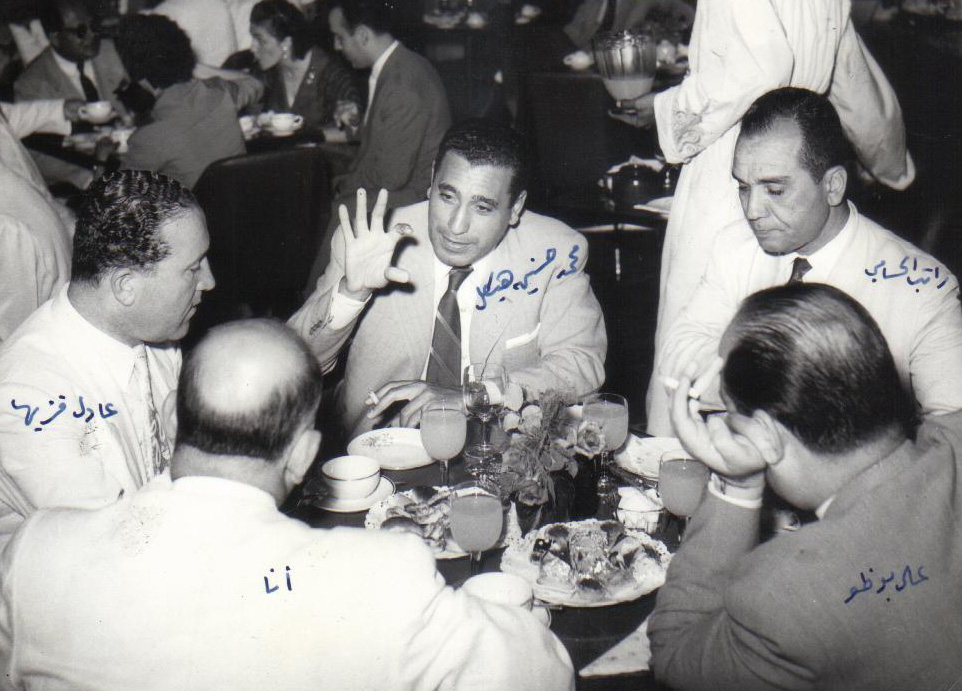
Mr. Mohamed Hassanein Heikal answered Al-Baath's own articles with an editorial titled "I Object." And so Mr. al-Bitar and his brothers' own true intentions grew clearer by the day, revealing themselves as men of pure deception.
Despite all this deception, we took care not to obstruct the course of the union talks, and tried to present the appearance of "agreement" within the coalition government, keeping our own "dirty laundry" out of the press's own hands.
The Lebanese newspaper Al-Anwar asked me by telephone for my own view of how the union talks were proceeding, and I answered, on 29 March, as follows:
"We took part in the six-member ministerial committee that drafted the federal union proposal, and we approve of everything achieved within this committee. We are the ones who drew up the Syrian proposal for tripartite union, in cooperation with the committee's other members, and brought our own proposal before the Council of Ministers, which approved it unanimously. We agree, in this proposal, on tripartite union between the United Arab Republic, Iraq, and Syria, and there is no disagreement whatsoever on this question among the parties in government. We therefore consider tripartite union a matter already agreed upon unanimously. We entered the ministry precisely to fulfill the Arab people's own demand in Syria, and to realize its own hope for union, and this lofty goal has been achieved in a manner that satisfies our own conscience and conviction.
Anything else said on this subject, then, is false and fabricated."[1]
Not everything I told the newspaper was entirely true, but we still held out hope for a sudden awakening of Mr. al-Bitar's own conscience.
For the record
Barada, 1 April 1963
---
Endnotes:
[1] The Damascus newspaper Barada, published by Mr. Munir al-Rayyes, printed this interview in its issue dated 1 April 1963.
Photographs
A photograph accompanying this section, from the family archive. Its caption is not shown here because the original extraction's photo-to-caption pairing could not be reliably verified.