Appendix (2): The 1958 Army Memorandum That Triggered the Union and the 1950 Constitution Radio Addresses
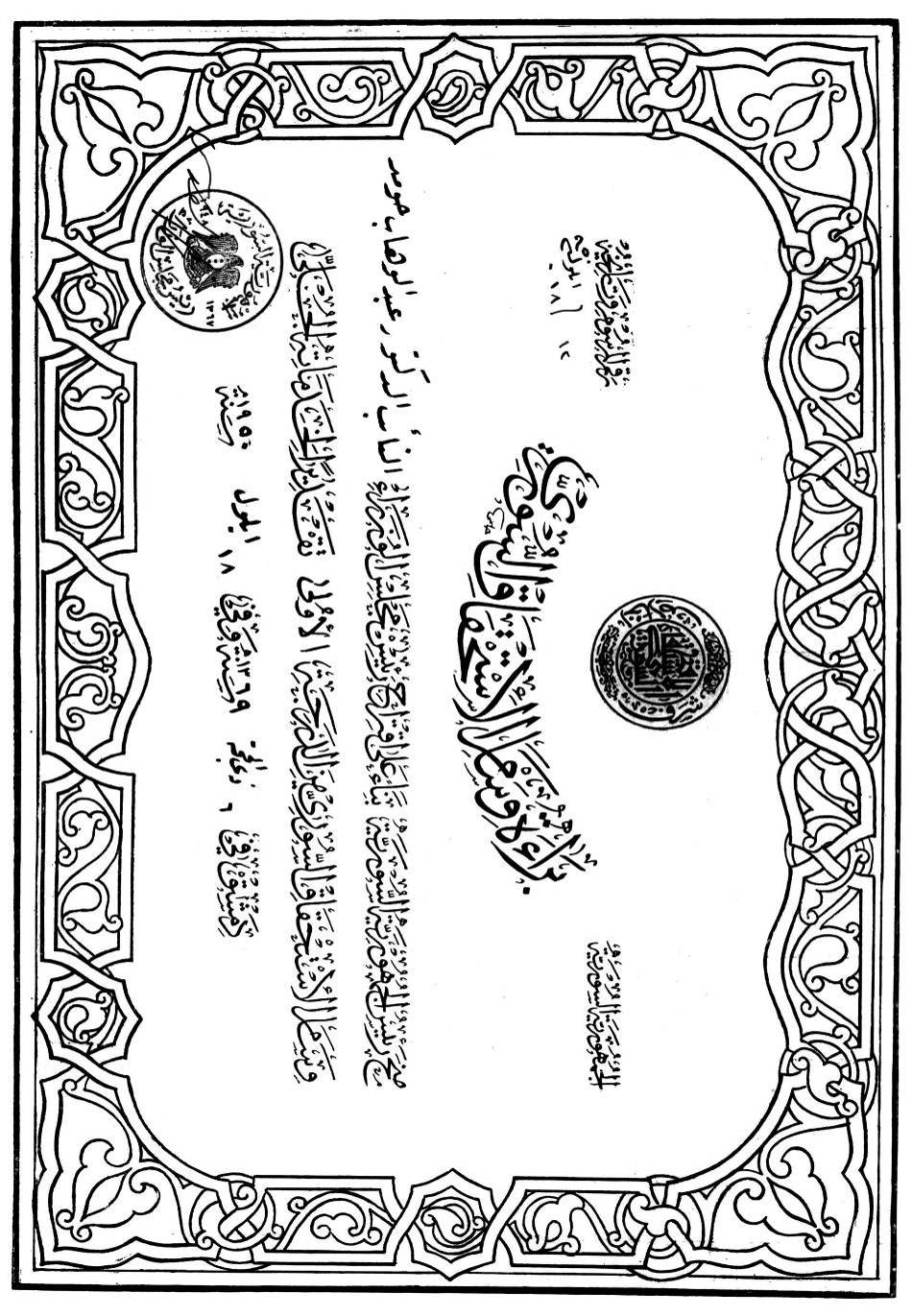
Document No. 1: Certificate of the Syrian Order of Merit
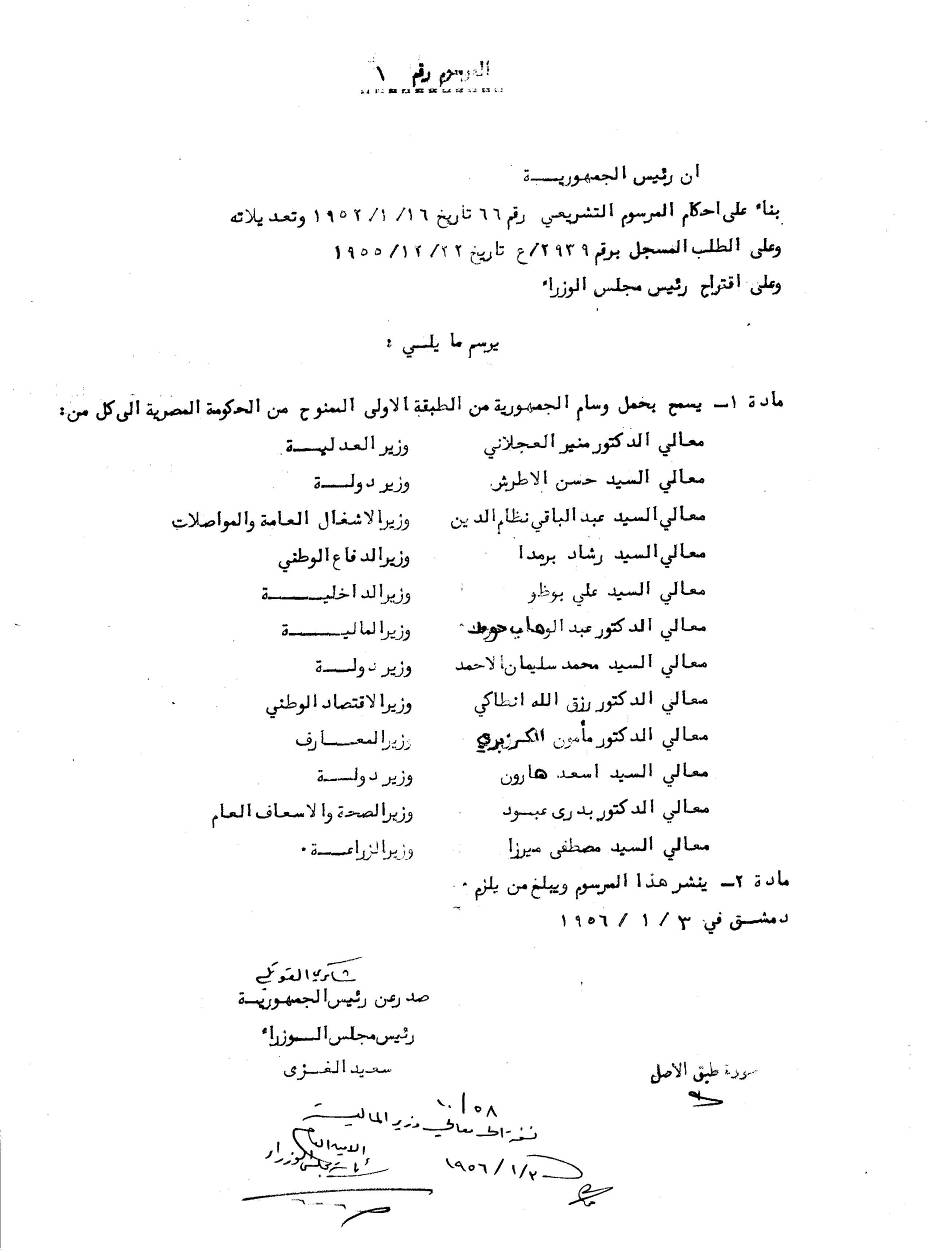
Decree No. 1
The President of the Republic,
Pursuant to the provisions of Legislative Decree No. 66, dated 16/1/1952, and its amendments, and to the application registered under No. 2939/A, dated 22/12/1955, and on the proposal of the Prime Minister,
Decrees the following:
Article 1: Permission is granted to wear the Order of the Republic, First Class, conferred by the Egyptian government, to each of the following:
His Excellency Dr. Munir al-Ajlani, Minister of Justice
His Excellency Mr. Hasan al-Atrash, Minister of State
His Excellency Mr. Abdul Baqi Nizam al-Din, Minister of Public Works and Communications
His Excellency Mr. Rashad Barmada, Minister of National Defense
His Excellency Mr. Ali Bouzo, Minister of Interior
His Excellency Dr. AbdulWahab Homad, Minister of Finance
His Excellency Mr. Muhammad Sulayman al-Ahmad, Minister of State
His Excellency Dr. Rizkallah al-Antaki, Minister of National Economy
His Excellency Dr. Mamoun al-Kuzbari, Minister of Education
His Excellency Mr. As'ad Haroun, Minister of State
His Excellency Dr. Badri Aboud, Minister of Health and Public Relief
His Excellency Mr. Mustafa Mirza, Minister of Agriculture
Article 2: This decree shall be published and communicated to whomever it concerns.
Damascus, 3/1/1/1956
Shukri al-Quwatli
Issued by the President of the Republic
Prime Minister, Said al-Ghazzi
Document No. 2: The Constitution of 1950
The Constitution of 1950
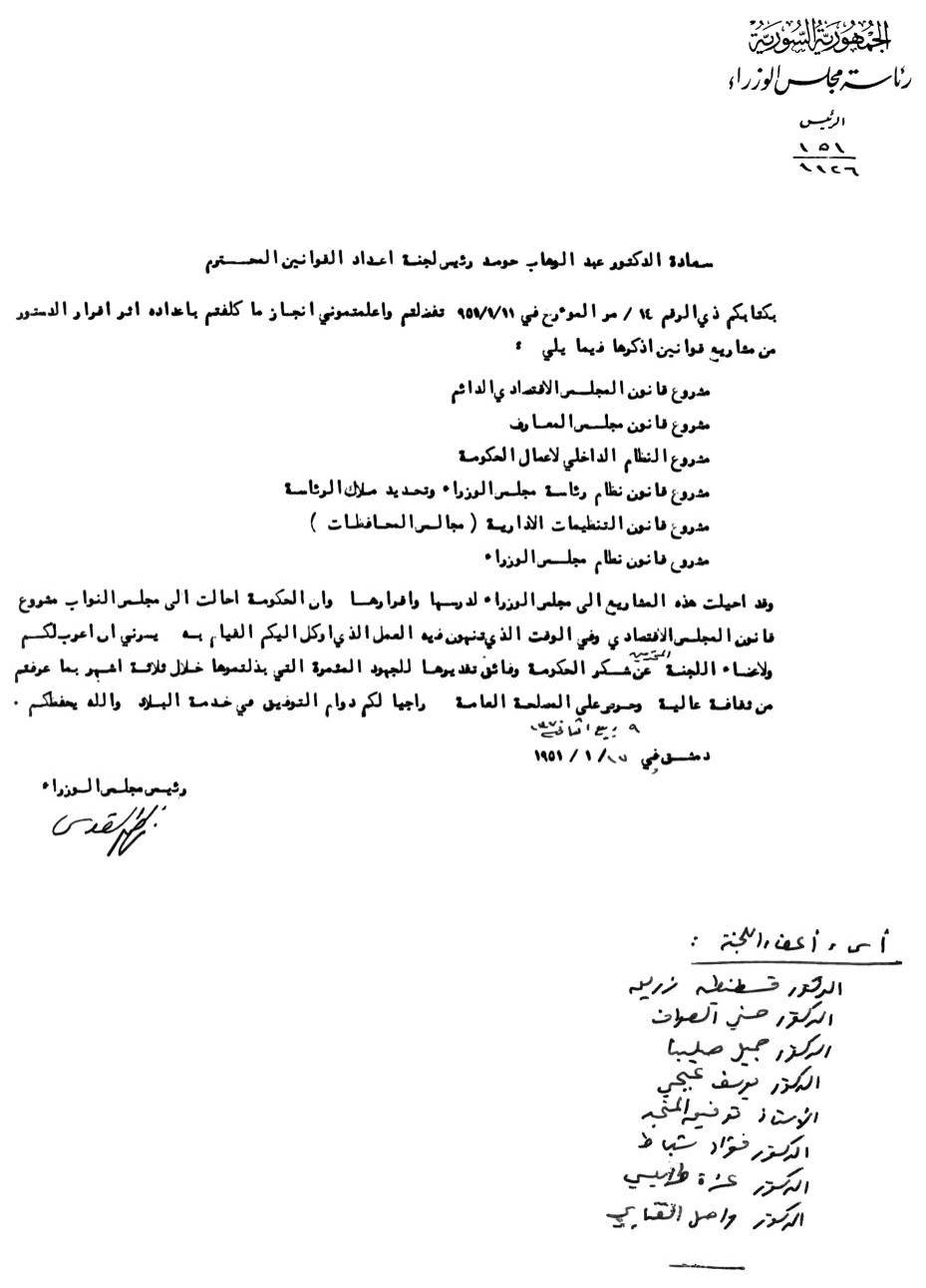
To His Excellency Dr. AbdulWahab Homad, Esteemed Chairman of the Law-Drafting Committee
In your letter No. 14/Marr, dated 11/1/1951, you were kind enough to inform me of the completion of the draft laws entrusted to your committee following the constitution's ratification, which I list below:
Draft law on the Permanent Economic Council
Draft law on the Education Council
Draft internal regulations for the conduct of government business
Draft law on the organization of the premiership and the definition of its staff
Draft law on administrative organization (provincial councils)
Draft law on the organization of the Council of Ministers
These drafts have been referred to the Council of Ministers for review and approval, and the government has referred the draft law on the Economic Council to the Chamber of Deputies. As you complete the work entrusted to you, it gives me pleasure to express to you and to the esteemed members of the committee the government's own thanks and its highest appreciation for the fruitful efforts you have made over these three months, marked as they were by high scholarship and a genuine concern for the public interest. I wish you continued success in the service of the country, and may God keep you.
Damascus, 17/1/1951
Prime Minister
Nazim al-Qudsi
Names of the committee's members:
Dr. Constantin Zurayk
Dr. Husni al-Sawwaf
Dr. Jamil Saliba
Dr. Yusuf Abaji
Dr. Tawfiq al-Munajjed
Dr. Fouad Shabbat
Dr. Ezzat Tarabulsi
Dr. Wasel al-Qabi
The First Address on the Constitution
An address delivered on the radio on the evening of Tuesday, 28 August 1950
Fellow citizens,
In a few days, God willing, Syria will have a new constitution, one its Arab sister nations will envy and take pride in, for it comes, I believe, as the most sincere expression of the nation's own hopes and aspirations, and its genuine wish for a life of dignity and productivity.
Our esteemed citizens will recall that the previous constitution was published by the French High Commissioner, under a decision he himself issued, No. 3111, dated 14 May 1930, after he had altered Articles 2, 17, 24, 35, 41, 67, and 68, and added Article 116, meaning he distorted the Constituent Assembly's own will through these alterations, then paralyzed the country's own will entirely through Article 116.
The French never once regarded the constitution they themselves had drawn up with any real respect, applying it, or suspending its own provisions, according to the ebb and flow of popular sentiment, revolt or calm, and according to their own military and political interests. For this reason, the previous constitution was little more than a tool in the colonizer's own hand, and once the darkness of occupation lifted from the country, the politicians of the national era themselves tampered with it further, stripping it of whatever sanctity it still held in citizens' own hearts.
For this reason, its own fall caused no uproar or commotion at all, but was, on the contrary, met with a joy no one can deny. If this phenomenon carries within it a real and serious danger, I implore God, glory be to His name, that the politicians of the present era, and whoever may succeed them in government, learn from this harsh lesson, and understand that governance is a sacred trust placed in rulers' hands, one that must be steered toward the public interest, never toward personal gain.
-2-
The esteemed Radio Directorate invited me to speak from the Syrian station to Syrian citizens, to set out the most prominent features of the new constitution, and the differences between it and the previous, now-abolished one, and I accepted this invitation gratefully, for it gave me the opportunity to acquaint my own countrymen with this constitution's own merits. It is, in truth, a humane, socialist document, resting on the idea of social justice and solidarity among citizens, aiming to build a strong nation through the fundamental reforms it introduces, directing the entire state toward serving the common good, and precisely defining the relationships between the powers of the state, so that none encroaches upon another through any ambiguity in the text.
-3-
The new constitution includes a preamble, setting out the great principles on which this fundamental law rests, its purpose being to remind citizens of their rights and duties before they read a single article of it. This preamble is itself an innovation, compared to the previous Syrian constitution, and to the constitutions of Egypt and Iraq alike.
These principles are:
1. Establishing justice on sound foundations. God Almighty said: "And when you judge between people, judge with justice," within a free republican order, in which judges are answerable to the people, the people answerable to the laws, and the laws answerable to justice itself.
The constitution's drafters placed the very greatest importance on establishing justice, making it their very first goal, for no one's rights can ever be secured unless judges are men of integrity, strong in their own character, noble in their own conscience, guided by their own personal conviction alone.
2. Guaranteeing basic freedoms to every citizen. The second goal states that it is the state's own duty to work so that the citizen genuinely enjoys these freedoms under the rule of law and order.
-2-
It becomes clear, from the reasoning given for guaranteeing public freedoms, that they represent the highest expression of human personality and dignity, clear proof of the deep respect the constitution's drafters hold for these public freedoms, which distinguish the free man from the slave, and the human being from anything less than human.
3. Spreading a spirit of brotherhood, and cultivating social awareness among citizens. This is a truly sacred goal, for a country like ours, home to so many different religions and sects, must make brotherhood its guiding principle for all, leading in turn to the cultivation of social awareness, so that the citizen does not think in narrow, individualistic terms, but works instead within the framework of the common good.
For this reason, the preamble before us requires the broad cultivation of this social awareness, so that every individual senses he is a valuable part of the nation's own structure, and that this nation loves him, respects him, and needs him.
All citizens have, praise God, already shown real proof of this spirit of brotherhood, but the nation still needs to strengthen it, and to cultivate social awareness further still, beyond its present level.
4. Reinforcing the duty to defend the homeland, the Republic, and the constitution. For the homeland is the very soil that nourished us with its own milk, that carries the traces of our own civilization, its very particles mingling the events of history with the remains of our fathers and forefathers. It is the people from whom we sprang, and among whom we grew up, who speak our own language, and carry, with us, both the past and the present, looking, as we do, toward a free, radiant future. The Republic is the system of government that has taken firm root in our people's hearts, who have repeatedly declared their own determination to hold fast to it, until it became our own constitutional tradition, the very center of gravity of our political being. And the constitution is this great charter that every citizen, whatever his religious or political conviction, holds sacred, this supreme law that lays out the plan of government and coordinates the effectiveness of its own powers. These three truths together constitute the very meaning of our national and political life, and for this reason the preamble provides for the giving of blood, money, labor, and knowledge for their own preservation.
5. Freeing citizens from the scourges of poverty, disease, ignorance, and fear. What duty could be more sacred than feeding the hungry, healing the sick, teaching the ignorant, and securing the fearful?
Since the root of these great afflictions lies in the poor state of the existing social order, its economic side especially, the preamble provides for the necessity of establishing a new economic and social order, to secure the goal sought from it. We note that the text says "establishing" an order, not "improving" the existing one, for merely improving what already exists would serve no purpose at all.
We shall explain, in the lectures that follow, what the framers intended by this sound economic and social order.
6. Guaranteeing equality in public duties and rights. This equality is not the traditional equality that merely says people are equal, but the true, correct equality in which people are equal in sacrifice and contribution, each according to his own capacity.
-3-
On this basis, taxes will be imposed on a progressive basis, not on a uniform rate, as was previously the case.
7. Strengthening, cultivating, and nurturing the individual personality. By this personality is meant every citizen, man or woman alike, for the nation is made up of the sum of these individual personalities. If they are unsound, the sum they produce will be unsound as well, but if they are strong and cultivated, the nation will be made up of strong, conscious cells, so that every citizen feels himself the first person responsible for the nation's own safety, for its present and its future, and knows his own duty toward this homeland, handing it on to his own children after his death, his own dignity intact and his own standing secure.
8. Holding fast to Islam and its own noble ideals, and building the state on the foundations of the sound morality this true religion brought, morality the other heavenly religions likewise foretold. This is a new principle, one absent from the previous constitution.
If the state holds fast to the hem of Islam, it is because Islam is the religion of the majority of citizens. Islam, in its various stages, of strength and of weakness alike, has proven itself a religion of love and tolerance, just as Muslims, in the days of both their own glory and their own subjugation, proved their own good treatment of the People of the Book, our Christian brothers especially, who have contributed, as we Muslims have, to building the greatness of the Arab homeland and its own eternal heritage, and who have tasted with us the bitterness of foreign rule, so that we have all been fused together in the great crucible of the homeland, each of us worshipping his own Lord according to the rulings of his own faith, while remaining, on the national plane, an Arab proud of his own Arabness, placing his own Arab bond above even his blood and his wealth.
9. Cooperation with the peoples of the Arab and Islamic worlds. This is the very least the duty of self-defense and the dignity of Arab brotherhood, and the right of neighborliness, demand. No Arab and no Muslim, in any corner of the earth, is unaware that the loss of martyred, struggling Palestine was not the result of a fair peace, nor of the fortunes of war, though it did arise from several causes, foremost among them foreign powers' own desire to tear us apart, and to plant intruders in our most sacred lands, so that they could be used to threaten us at every hour we resist their own colonial and commercial ambitions.
10. The Syrian people are part of the Arab nation, with its long and eventful history, its troubled and alarming present, and a future we cannot glimpse through the veil of the unseen. Our Syrian Arab people will spare no effort in gathering the Arab nation's own scattered ranks into a single state, extending, as the great empires once did, from the Persian Gulf to the Atlantic Ocean, so that history repeats itself, and we return to being masters in our own homelands, respected in the international community. The oath taken by deputies, and the oath taken by the President of the Republic, both include the duty of working to unify the Arab countries, a provision with no equivalent in the previous Syrian constitution, nor in the constitutions of Egypt and Iraq, nor in the constitution of our sister Lebanon, for none of these constitutions were drawn up in a free, unconstrained atmosphere.
These are the ten goals upon which the structure of the new Syrian constitution rests, enacted in a free atmosphere and by the will of the Syrian people alone. These are sacred goals, ones every Syrian, not deputies and politicians alone, has a duty to fulfill.
We shall see, in our coming addresses, how the new constitution charted the path to achieving them. Until our next address, God willing.
AbdulWahab Homad
The Second Address
Fellow citizens,
In yesterday's address, I spoke of the constitution's preamble and the ten principles on which our own fundamental law rests, and promised to speak of the paths its own articles chart toward achieving these noble goals.
Today's address will cover the first chapter and part of the second. I am pleased to state, from the outset, that these studies are not deep works of legal scholarship, but general talks, aiming at introduction rather than analysis, description rather than deduction.
The first chapter deals with the form of government:
Syria, as under the previous constitution, is a parliamentary republic, of complete sovereignty, its language Arabic, its president's religion Islam, its capital Damascus, and its flag the very flag that flies above our own heads, representing our own dignity and national honor.
But the new constitution includes, in this chapter, matters absent from the previous one: it provides that Syria is an "Arab republic," and that the Syrian people are part of the Arab nation. None of this appears in the constitutions of Egypt, Iraq, or Lebanon.
And so Syria, liberated, praise and thanks be to God, from every foreign restraint, has given clear, unambiguous proof, in its own constitution, that it embraces the idea of the great Arab state.
Article 15 of the new constitution gives practical application to this lofty Arab idea, stating: "The law shall grant special facilities to Syrian expatriates, their children, and the children of other Arab countries."
I hope the day will come when our own Syrian nationality is granted to every Arab who resides in Syria for even a few days.
The first chapter includes further matters of no less importance:
Article 2 provides that sovereignty belongs to the people, and may not be claimed by any individual or group, and that this sovereignty rests on the principle of government of the people, by the people, and for the people. This principle represents the very idea of genuine democratic government, the very principle championed by the famous American president Abraham Lincoln, and now written into the final clause of Article 2, and into the modern French constitution as well. This principle means that the people can be ruled only by themselves, through individuals from among their own number, freely elected, with this government directed toward the people's own interest, not that of the rulers.
Islamic jurisprudence has become the main source of legislation for us, a great gain for the new constitution, for it thereby preserves the heritage of our own great jurists, whose merit has been recognized by everyone who has ever practiced the craft of legal scholarship, in East and West alike. There is no doubt that any nation that severs its own ties with its past loses a great many of the pillars of its own political and social life.
The second chapter, meanwhile, includes the fundamental principles, the very pillars on which the structure of society rests, defining citizens' own rights and duties.
The very first of these principles is the guarantee of public freedoms, which the constitution's preamble describes as "the highest expression of human personality and dignity." These freedoms are numerous, surrounded with great care and respect, so that there is no room for tampering with them through reckless legislation.
The first of these freedoms is freedom of belief, absolute for all the heavenly religions, a principle now firmly established in our own constitutional life, for Islam itself foretold it, in God's own words, "there is no compulsion in religion," a principle enshrined in Article 15 of the old constitution, and stated explicitly in Article 3 of the new one.
The second is personal freedoms, and Article 10 sets out the main application of this principle:
Every person is presumed innocent until proven guilty by a lawful judgment, and no one may be investigated or detained except in the specific cases exhaustively listed in the second paragraph of the article in question.
Administrative authorities are forbidden from placing anyone under preventive detention, and the integrity of the right to legal defense is guaranteed at every stage of a case, both during investigation and before the courts of judgment.
Exceptional courts have been abolished, and military courts' own jurisdiction has, in principle, been confined to members of the army alone.
It has become the duty of any authority arresting a person, in the three cases the constitution specifies (a judicial order, a flagrant offense, or the intent to bring him before the judicial authorities on a charge of committing a felony or misdemeanor), to inform him, in writing, within 24 hours, of the reasons for his arrest and the legal provision under which he was arrested, and he must be handed over to the judicial authorities within 48 (forty-eight) hours at the very most from the date of his arrest. Given that the constitution grants him the right to object to his detention immediately, through a lawyer or a relative, and obliges the competent judge to review the matter at once, the very abuses people once complained of have now been removed.
The constitution did not overlook the importance of prisons, noting that it regards them not merely as places of punishment, but as places of reform as well. Citizens are aware that the true state of our own prisons is a truly sad one, for prison teaches the very arts of wretchedness, given the alarming mixing of prisoners of every kind, and the corruption of jailers, and their own poor methods, which do nothing but harm prisoners' morals, upbringing, health, and conduct.
These freedoms also include the sanctity of the home, the privacy of postal and telegraphic correspondence, and the non-extradition of political refugees, those who enter Syria fleeing the persecution, injustice, and arbitrary treatment they face in their own countries, on account of their political convictions, at odds with those of their own rulers, or on account of their defense of sacred liberty.
Though this principle is a customary one internationally, it was absent from the previous constitution, and does not appear explicitly in the constitutions of the other Arab states. The very first constitution to provide for it was that of the French Revolution, in 1793, which stated: "The right of asylum is granted to foreigners banished from their own homelands in defense of liberty, and this right is refused to tyrants." The English statesman Lord Palmerston wrote this famous dispatch: "If there is one rule that has been more respected than any other in modern times, it is the non-extradition of a political refugee. The laws of hospitality, the demands of humanity, and human sentiment itself, all combine to forbid the extradition of such a refugee.
And any independent government that does so brands itself as one that understands nothing of honor."
Two such incidents occurred in Syria over the past ten years, which we recall with real bitterness and sorrow.
The third of these freedoms are the social and political freedoms, by which we mean the following:
1. Freedom of opinion, fully guaranteed by the state.
2. Freedom of the press, which may not be suspended nor its license revoked except in accordance with the law.
These two freedoms allow every Syrian to say what he pleases, and write in the newspapers what he wishes, on a single condition, that he not exceed the bounds set by the penal code on the matters of slander, defamation, and libel. There is no doubt that in permitting freedom of speech and writing, the constitution has also affirmed respect for others, and forbidden wounding their own dignity or insulting them, a principle firmly established in constitutional jurisprudence, since an individual's own freedom ends where the freedom of others begins.
3. The non-exile of Syrians from their own homeland's soil. With this, the penalty of exile provided for in Article 47 of the penal code has been abolished, though a special law must still be issued to this effect, in accordance with the transitional article.
4. The right to assembly and demonstration, provided it takes place in a proper manner. This is an obvious right, for learning citizens' own views on their country's policy and the conduct of its affairs.
5. The right to form charitable associations, not aimed at material profit, such as relief societies, and associations working to spread culture, the arts, and to take destitute children by the hand.
6. The right to form political parties, provided they meet the following three conditions:
a. That their own aims be lawful, that is, not forbidden under the penal code, such as parties aiming to separate part of the Republic's own territory.
b. That their own means be sound, that is, that they work to achieve their own goals through constitutional methods, thereby forbidding terrorist parties, and parties of a military character.
c. That they have democratic structures, that is, that their own programs be consistent with the constitution's own goals. No political party may be formed if its own purpose is to transfer sovereignty away from the people, confining it instead to the hands of an individual or a group, as with dictatorial parties, or parties wishing to tamper with the system of basic freedoms the constitution guarantees.
And so our new constitution, through the modern principles it introduces, and through the earlier principles it expands and refines, stands, in this respect, at the very forefront of the constitutions of the Arab world.
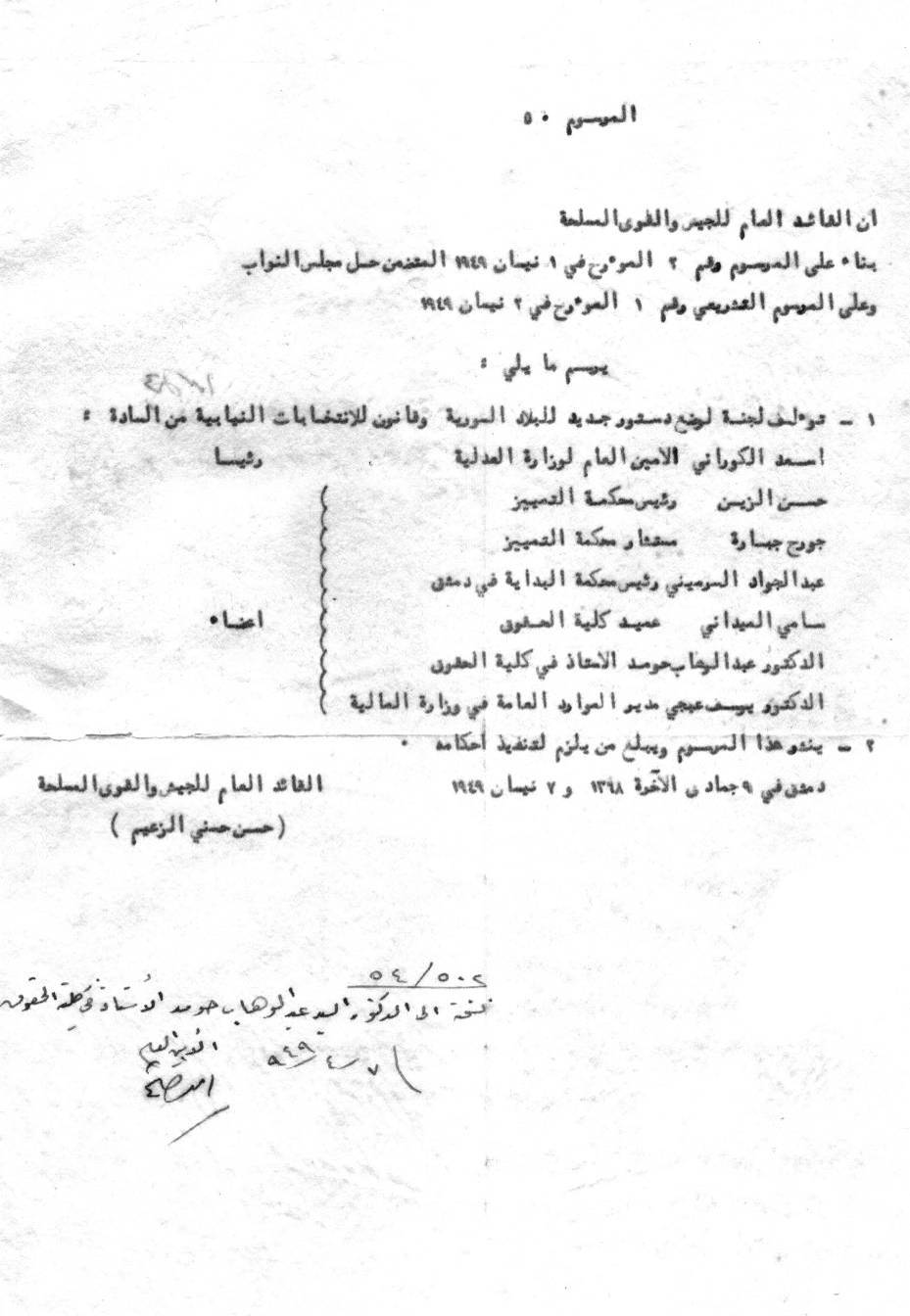
Decree No. 50
The Commander-in-Chief of the Army and Armed Forces,
Pursuant to Decree No. 3, dated 1 April 1949, providing for the dissolution of the Chamber of Deputies,
And to Legislative Decree No. 1, dated 2 April 1949,
Decrees the following:
1. A committee shall be formed to draft a new constitution for the Syrian country and a law for parliamentary elections, made up of:
As'ad al-Kourani: Secretary-General of the Ministry of Justice
Chairman
Hasan al-Zein: President of the Court of Cassation
Members
George Jabbara: Counselor at the Court of Cassation
Abdul Jawad al-Sirmini: President of the Court of First Instance in Damascus
Sami al-Maidani: Dean of the Faculty of Law
Dr. AbdulWahab Homad: Professor at the Faculty of Law
Dr. Yusuf Abaji: Director of General Resources at the Ministry of Finance
2. This decree shall be published and communicated to whomever it concerns, for the implementation of its provisions.
Damascus, 9 Jumada al-Akhira 1368, corresponding to 7 April 1949
The Commander-in-Chief of the Army and Armed Forces
(Husni al-Za'im)
54/502
A copy to Dr. Mr. AbdulWahab Homad, Professor at the Faculty of Law
7/4/1949 - Secretary-General
Document No. 3: The Historic Unity of the Syrian Army's Commanders
Za'im Amin al-Nafouri had submitted an important document, in his own name and that of his fellow army commanders, to the President of the Republic, the Prime Minister, the Speaker of the Chamber of Deputies, and the Minister of Defense, Khalid al-Azm.
He informed him that he and his colleagues, the Chief of the General Staff and the heads of its various branches, namely:
Afif al-Bizri, Abdul Hamid al-Sarraj, Ahmad Abdel Karim, Mustafa Hamdoun, and others, had met and discussed the question of federal union with Egypt, and found it preferable that this union take the form of comprehensive, full unity instead. For this reason, they formed a delegation of officers, headed by Mr. al-Bizri, and traveled after midnight to Cairo, to bring their own decision to President Gamal Abdel Nasser.
Below is the text of the memorandum containing the demands of the officers in question:
The Grounds:
Ever since history first knew a people called "the Arabs" in the Arabian Peninsula, the Arabs, throughout ancient history, bore characteristics that stamped the various countries speaking Arabic with a single character, that of struggle, liberation, and independence from the influence of the ancient empires.
The wave that emerged from the Arabian Peninsula, once it was unified into a single state and a single human creed, spreading across long centuries throughout the Arabian Peninsula and settling between the Arabian Gulf and the mountains of Persia in the east and the Atlas Mountains in the west, and between the Taurus range in the north and the Indian Ocean in the south, permanently rooted the foundations of this nation, and inscribed in the history of humanity remarkable pages of a human civilization this nation itself created and offered, its fruits within easy reach of every people. Wave after wave of barbarism followed, converging to shatter this human civilization and erase its very being over ten centuries. As a result, this nation was torn apart into many separate small states, yet its own civilization remained alive within every one of its sons, whatever their own intellectual or social standing, and a fixed idea remained etched in each of their consciences, one that could never be erased, of their own past identity and their future aspirations.
Struggle and liberation, in modern Arab history, played a real role in realizing this idea within the hearts of millions of Arabs.
The complete independence and liberation of some Arab peoples served as a spark for uprisings across other parts of the Arab homeland, and a spur to struggle for other peoples still seeking independence and liberation, in fulfillment of this same idea, rooted in the conscience of every Arab.
From all this, it becomes clear that the union between Egypt and Syria is nothing less than a national necessity, arising from a shared past, present, and future among the members of a single Arab nation, in fulfillment of a single, comprehensive unity befitting the modern age, and as a contribution to eliminating colonialism from the world, building humanity, and cementing its own mission. The two countries have expressed their own will toward complete unity on numerous national occasions, and have fought fierce battles for its sake against internal reaction and external colonialism alike, until they reached this very stage, in which they were able to officially declare their own will, through their own representatives in both countries, at the historic session held in Damascus on 18 November 1957. This was a victory for Arab nationalism, following a terrible struggle against colonialism, one the Arab people waged during the Tripartite Aggression against Egypt in 1956, and during the American-Turkish-Zionist colonial campaign against Syria in 1957.
This historic decision shook the very foundations of colonialism, which began gathering its own ranks in successive conferences held with its own allies in Ankara, Paris, Baghdad, and Tehran, mobilizing its own agents and collaborators, organizing them into blocs, and drawing up plans to prevent this decision from ever being carried out.
Since the present circumstances, arising from our Arab people's victory in Egypt and Syria, have linked our own Arab cause to world peace to a considerable degree, and opened the way for us to take rapid, positive steps commensurate with the importance of our own victories, and given the possibility that these circumstances and occasions might change, especially should colonialism manage to complete its own preparations to risk waging a comprehensive or local war, owing to the threatened disappearance of the interests it relies upon for its own basic survival in our Arab homeland, we therefore call for the necessity of hastening to establish the basic structure of comprehensive union with Egypt, and to begin implementing it immediately, overcoming every artificial obstacle, whether constitutional, directly political, or economic. We consider any continuation of the current local arrangements to have become an unnatural state of affairs, one whose survival rests on nothing but inherited colonial justifications and reactionary, opportunistic privileges that can no longer be recognized, now that the entire people has approved full, undiminished union.
The Form of Union: For this reason, we believe the unified state should be built along the following broad lines:
1. A single constitution declaring the establishment of the new Arab Republic, laying out its own system of government, and leaving room for the rest of the Arab peoples, once liberated, to join it.
2. A single head of state.
3. A single legislative authority.
4. A single executive authority.
5. A single judicial authority.
6. A single flag, and a single capital for the Arab state.
7. Laws governing citizens' rights and duties in the new state shall be enacted on the basis of this single constitution.
Defense Unity:
As for military unity, we believe it should rest on the following foundations:
1. A supreme commander of the armed forces of the new Arab state (the President of the Federal Republic).
2. A supreme defense council.
3. A general command of the armed forces.
4. Unified armed forces (land, sea, and air), unified in organization, armament, training, and equipment, distributed according to the requirements of defense and the defense plans set for the theaters of operations across the federal state's own territory.
5. A single budget.
The General Command of the Syrian Army and Armed Forces, conscious of its own national responsibilities and its own historic mission, and faithful to the Arab people of Syria, who have entrusted it with the responsibility of defending its own survival and safety, hereby declares that any union not built on the foregoing foundations is nothing more than an alliance between two armies belonging to two separate states.
For the requirements of defense, and the safety and preservation of the nation's own being, in our present age, demand the merging of the liberated Arab peoples into a single entity, so that they may contribute to liberating the rest of the Arab homeland, and fulfill their own duties in preserving world peace.
The General Command likewise declares, in the name of all the armed forces, that it stands fully ready to shoulder every defensive duty that immediate union requires, and considers itself, from this moment forward, bound to carry out whatever orders and directives it receives from the unified general command, whatever this may entail.
At the same time, any government or faction that hesitates in carrying out this union shall bear the gravity and consequence of its own action before the whole Arab people, and before the rising generations of Arabs to come.
Damascus, 11/1/1958
The Commander-in-Chief of the Army and Armed Forces
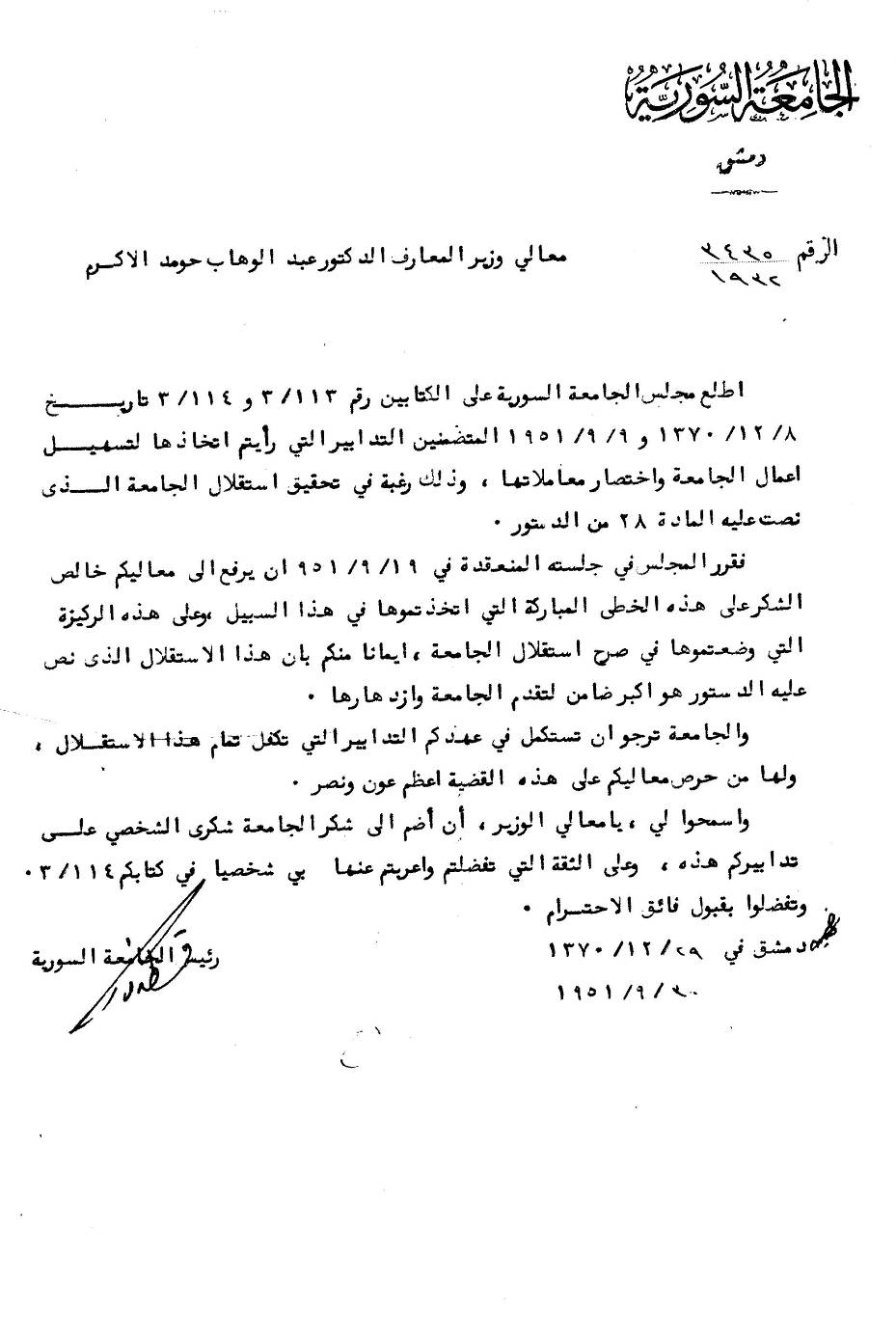
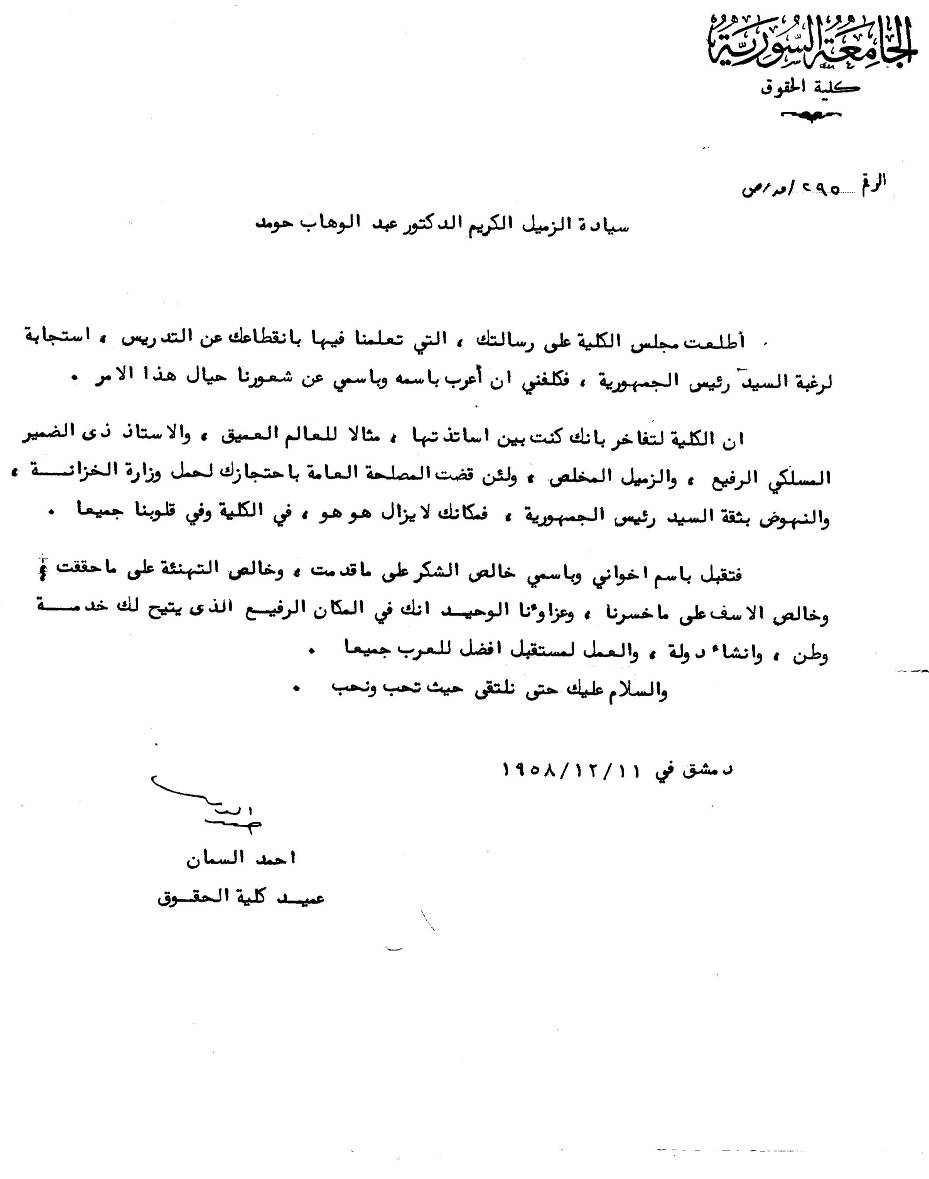
Document No. 4: Letters Addressed to the Author from the Presidency of the Syrian University
Document Facsimiles
Scanned images of the original documents discussed in this appendix, from the family archive.