Chapter 10, Part 7: Al-Shishakli's Rule and Its Fall in February 1954
Section Four
The Period of al-Shishakli's Rule
Immediately after civilian rule was overthrown in the second coup carried out by Colonel al-Shishakli, and the members of the government and some politicians were arrested on the twenty-ninth of November 1951, the President of the Republic, Hashim al-Atassi, submitted his resignation in protest at a military rebellion without any reasonable cause.
The leader of the coup, al-Shishakli, issued Military Communiqué no. 1 to the people, announcing that the Supreme Military Council, in view of the resignation of the President of the Republic and the absence of a government in the country, ordered that the chief of the general staff and president of the Supreme Military Council (that is, al-Shishakli himself) take on the duties of head of state, and also take on all the powers granted to the executive authorities.
From 2 December 1951 decrees would be issued by the chief of the general staff, president of the Supreme Military Council (Military Communiqué no. 1 of 2/12/1951). On 3 December 1951 Colonel Adib al-Shishakli issued Military Order no. 2, by which he vested Brigadier Fawzi Selu with the legislative and executive powers and the exercise of the powers and functions of head of state, Prime Minister and Minister of National Defense" until parliamentary life was restored to the country, and also gave him the right to issue legislative decrees.
An order was issued dissolving the Chamber of Deputies (which had originally been the Constituent Assembly) as from 2/12/1951, and another order dissolving all the political parties.
Brigadier Selu went on ruling the country alone on al-Shishakli's behalf until 7 June 1952, when Brigadier Selu issued a decree forming a new government, in which he himself held the premiership and the ministries of Defense and the Interior.. Colonel al-Shishakli joined it as deputy Prime Minister and Minister of State.
But he remained chief of the general staff, so as to keep his grip on military power. Most of this cabinet was a mixture of merchants (Sa'id al-Za'im, Munir Diab and Abd al-Rahman Hunaydi) and the group of the Arab Nationalist Party (Zafir al-Rifa'i and Munir Ghannam), in addition to three independents, none of whom was known to have had any previous political activity (Murshid Khatir, Sami Tayyara and Tawfiq Harun).
These people became the nucleus of the only new party al-Shishakli allowed to be founded, the Arab Liberation Movement (Hizb al-Tahrir al-Watani). Its head, in practice, was Adib al-Shishakli. In founding it he relied on the old members of the Syrian National (Social) Party, of which he himself had been a member. "And they were joined by a clique that was loyal neither to him nor to the homeland that had raised and fed them."[1]
On 16 June 1953 the "Military Council" ordered His Excellency the Major General, head of state and Prime Minister, to hold a referendum on a new constitution which this Military Council had presented to the government, and also to elect a President of the Republic.
The government set 10 July 1953 for the referendum on the constitution and the election of the President of the Republic. The people condemned this contempt for their dignity on the part of a group of opportunists with no roots in the country, about whose leanings no one knew anything.. Demonstrations broke out in some cities, but they were met with unjust repression.
I remember that eleven bombs were set off in Aleppo alone, merely to trouble the authorities and let them know that the people did not agree with what they intended to do.
One of the two who supervised the bombings was the late Abd al-Fattah al-Zalt, a lawyer and a prominent member of the Arab Socialist Party headed by Akram al-Hourani. The other was from our side, acting on his personal responsibility.. and a hint sometimes gives away what is not said outright.
The leaders of the country came together to stand up to al-Shishakli, and addressed a memorandum dated 20/6/1953 to him in his capacity as "chief of the general staff and the person chiefly responsible for the present situation", thereby ignoring the head of state. It said:
"Our country is today run with absolute power by one-man rule.. Its first sign is the complete loss of public freedoms, which has led to a kind of repression among citizens.. And this has been followed by people's feeling that the law does not rule.
The present regime has dissolved the political parties, confiscated their funds and closed their offices. But it itself sponsors and fosters a new movement which, in truth and in fact, is the sole political party in the country, living on the remains of public and individual freedoms.
In addition, a number of citizens are thrown into prison without any known charge.. We wish to point out that the nation's constitution is not drawn up in government offices and by some of its officials.
Accordingly, publishing the constitution in the way you intend will not bring the country out of one-man rule, nor prepare it for the transition to sound consultative government; it is one-man rule in another form.
The facts of recent history through which we have passed call on you to restore to the nation its rights to freedom and sovereignty."
This statement was signed by the general commander of the Syrian Revolt, Sultan al-Atrash, and a large number of the country's politicians from various parties and tendencies.
This statement won the support of His Excellency President al-Atassi in the form of a separate statement attached to the politicians' statement.
But no sign came from al-Shishakli that he would respond to the people's wishes. Then Rushdi al-Kikhya moved and began contacting the political leaderships to obtain their agreement to hold a general conference at which one-man rule would be openly and publicly denounced. He charged me with traveling to Latakia, Idlib and Damascus to contact the politicians there and obtain their signatures agreeing to attend a conference to which they would be invited.
The place of the conference was fixed in Homs, at President al-Atassi's house, and its date on 4 July 1953.. Al-Shishakli tried to prevent the conference from being held, placing military police checkpoints at the entrances to the cities to turn back those going to it.. They turned me back from the Saraqib area to Aleppo, but I tried again.. and reached Homs with some colleagues.
Before the referendum on al-Shishakli's "constitution" the country's leaders addressed a "historic" appeal to their people, urging them "not to fall into the trap of the referendum set for you, and to take the stand your dignity, patriotism and freedom dictate.. and to prove, O people, to the tyrant rulers and to the whole world that you are not driven to your death like grazing cattle, and to know, O noble people, that the day of the referendum is a day of general mourning in Syria, and national duty requires you to stay at home that day and not leave it, and to declare your silent general strike, boycotting the imposed and fraudulent referendum".
The national conference was held in Homs on schedule and lasted several days. Those attending it ended by addressing a grave statement to al-Shishakli and the people, demanding an end to this abnormal regime and a return to the people's wishes to recover their freedom and their sound institutions.
Despite all the warnings the leaders gave, coupled with the people's declaration of their displeasure with the conduct of those holding power, al-Shishakli was headstrong and went on along his thorny path, and announced the people's "vote" for his constitution and his election as "President of the Republic".
This "constitution" had the character of a presidential system. It consisted of 129 articles. Its Article 181 provided for the President of the Republic to be elected directly by the people for a term of five years, and he would be assisted in exercising executive power by "ministers of state" whom he appointed and dismissed (Article 94).
When Adib al-Shishakli became President of the Republic, he formed a cabinet under himself from among his supporters. Of our brothers, Dr. Anwar Ibrahim Pasha joined it. I know of no acceptable reason for his becoming a minister, for Anwar was my companion at secondary school and my colleague at the University of Paris; we lived through the Second War together and specialized in the study of criminal law. He was known for his integrity and his pride in his dignity. So what drove him to break with us and join a hateful regime?
The country met the constitution and the "President" with complete aversion and repugnance.. and popular movements began to stir.
In Baghdad the Syrian refugees formed a "Free Syrian Government" headed by Colonel Muhammad Safa on 15/10/1953. I believe that such a government was not the kind of thing to worry al-Shishakli, unless it relied on Iraqi Arab support.. But what worried him and shook the pillars of his regime was what happened at home: stormy demonstrations in Aleppo and Homs especially, and clashes between the police and the demonstrators, especially the throngs of students.. Al-Shishakli feared armed movements in Jabal Druze, and hastened to send large military forces there.. Bloody clashes did take place in several areas, after which Sultan al-Atrash left the country for Jordan with a number of his men.
Al-Shishakli followed these actions by declaring martial law on 27 January 1954, and arrested 24 politicians, among them, from the People's Party, Rushdi al-Kikhya, Ali Bouzo, Shakir al-As, Faydi al-Atassi and Rizqallah Antaki; from the Baathists, Akram al-Hourani, Michel Aflaq and Salah al-Din al-Bitar; and from the independents, Munir al-Ajlani, Hasan al-Atrash, Abd al-Rahman al-Kayyali and Ihsan al-Jabiri.. Sabri al-Asali was also arrested.
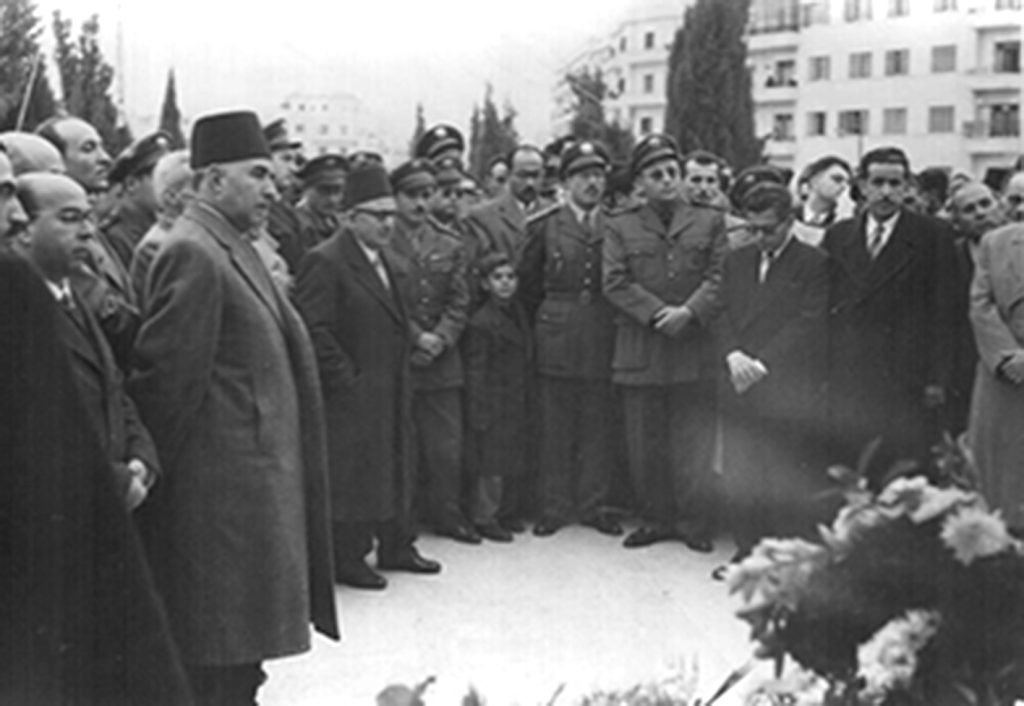
He placed President al-Atassi under house arrest in Homs, and Sultan al-Atrash in al-Suwayda.
In Aleppo, Dr. Nazim al-Qudsi, Abd al-Aziz al-Hallaj and I were placed under house arrest.
The policeman posted at the door of my house to stop me going out or receiving anyone was very sympathetic toward me.. I used to go out at night with his consent to Dr. al-Qudsi's house or al-Hallaj's.. to confer on the questions of the hour.
The late Rashad Jabri brought me a message about joining the leaders who were outside the country at al-Azraq in Jordan, but activity of this kind does not attract me, and I would rather not say why.. so as not to offend the judgments of others.
The smell of a new coup began to spread through the city.
Among the signs was what the late Kamil Hananu told me when he visited me, that "talk of a coup is on every tongue", and what Leon Zamaria (of the National Party), who had remained free, told me about his "outings" in the car with Colonel Faisal al-Atassi, one of the senior officers of the Aleppo force.
Once he said: "the rattle is ripe".. and I understood from this that a military move against the regime was imminent.
The certain news came when the late Abd al-Fattah al-Zalt knocked at the door of my house on the morning of 25 February 1954 and said to me: "they are waiting for you at headquarters". When I asked him to explain, he said: a movement has broken out in Aleppo led by Colonel Faisal al-Atassi and Captain Mustafa Hamdun.. And we listened to the statement on Aleppo radio:
"This is Ra'is Mustafa Hamdun" (that is, captain, as the rank is called today)..
And so we went to the army command, in al-Jamiliyya, not far from my house.. There I saw Colonel al-Atassi behind his desk, and before him stood a young officer in field uniform, whom the colonel introduced to me, saying: this is Mustafa Hamdun.. Colonel al-Atassi looked anxious, but Mustafa Hamdun was completely composed.. despite the obscurity surrounding the situation.
We were called to a meeting in Homs as soon as possible, because reports suggested that al-Shishakli was able to crush the movement..
In Homs, Ali Bouzo took me with him to the garrison headquarters. The commander there was his close friend, Brigadier Mahmud Shawkat.. We stayed with him a long time trying to persuade him to support the Aleppo movement, but he was hesitant.. and kept making telephone calls.. Al-Shishakli took a wise decision and left the country, so that there would be no armed clash between units of the army.. His deputy, Brigadier Shallash, told me that al-Shishakli handed him a large sum of money that the Saudi government had donated to the armed forces, to give it to the new Syrian government.. He could have taken it with him, because it was a quantity of banknotes in a black bag.. but he did not.[2]
Brigadier Shawkat learned the news, telephoned Damascus and announced that he was joining the movement, and he threatened Ma'mun al-Kuzbari, who had become acting President of the Republic as president of the Chamber of Deputies, that he would hang him if he marched on Damascus and al-Kuzbari fell into his hands.. We were sitting in his office listening to this firm threat.
In Damascus some officers whose survival was bound up with al-Shishakli's regime forced the chief of the general staff, Brigadier Shawkat Shuqayr, to march from the general staff headquarters to the Chamber of Deputies, and forced al-Kuzbari to take over the leadership of the regime under threat.
But in practice al-Shishakli's regime was over. His senior men scattered across the borders, and Ma'mun al-Kuzbari left for Lebanon on 27/2/1954 to save himself. When news of these "departures" across the borders reached our ears, one of our brothers quoted the poet:
In the thick of battle I never tested myself,
but in defeat I am like the gazelle
What happened after that was explained by Jalal al-Sayyid in a speech in the Chamber of Deputies after legitimacy returned to the country. He said:
"On the morning of the coup the chief of the general staff came to Mezzeh Prison and told us the truth of the matter, the defeat of the tyrant and our release. He said that the army was a single bloc and had authorized him to inform us that it had withdrawn from the field of politics for good and returned to its barracks, and he told me to hand political affairs over to those to whom they belonged, that is, to us, the detainees representing the political parties and the independent bodies that had signed the Homs Charter."[3]
Endnotes:
[1] From an editorial in the newspaper al-Ayyam, owned by Nasuh Babil, issue 21, March 1954.
[2] Adib al-Shishakli was born in Hama in 1909.
He was assassinated in Brazil on 27 September 1964; his body was brought back to his country, and the killer was arrested.
[3] Minutes of the session of 17 March 1954.