Chapter 13, Part 6: The Labor Pains of Union: Exile and Farewell
Although Rushdi al-Kikhya had withdrawn from the political limelight, he remained the object of President Abdel Nasser's particular respect. I would like to mention two incidents that show Abdel Nasser's feelings toward him:
The first: I was once visiting President Abdel Nasser at his modest house in Manshiyat al-Bakri in Cairo to study the budget, after he had chosen me for the Ministry of Finance. During a break he smiled and asked me: How are our brothers in Aleppo? I found it a good opportunity to dispel some doubts. It had reached my ears that several reports had been sent to him saying that I was in touch with members of the People's Party.. I said to him: This is a fine occasion, Mr. President, to make my position clear without ambiguity: I am in close touch with Rushdi al-Kikhya and the rest of our friends. It would not be honorable for a coolness to arise between me and them.. And if my ties with them affect the course of my work as a minister, then I ask you to choose someone else for the Ministry of Finance.. As for me, I will go on serving my country as a university professor, which is my original profession and my national calling.
The President was surprised at what I said, and replied: On the contrary, we want to win over all people.. especially good men like these.. And I officially charge you to go on my behalf and greet them in their homes in Aleppo when you return to Damascus.
And I did what the President asked of me..
The second: when President Gamal Abdel Nasser came to Aleppo, the city gave him a welcome such as it had never seen before. I greeted him in the name of the city, that fighting, unionist city, in a speech I gave in the square of the al-Aziziyya quarter to hundreds of thousands of the people of fighting Aleppo. He was in the best of spirits. Surging waves of people converged on the palace where he stayed (the palace of the Sa'im al-Dahr family) in the al-Muhafaza quarter, and the police had to push the crowds back to avoid accidents from the crush.. Rushdi al-Kikhya and Nazim al-Qudsi came to greet him along with the others welcoming his arrival. But the policemen kept them from coming near the entrance of the palace, and one of them pushed Rushdi in the chest with his hand, so the two men left.
When I learned of this, I went into the President's office and told him what had happened. He was very displeased and asked me to have them come at a time he set for them the next day.. So I went and brought them, and they went in to him and sat with him for nearly half an hour, then came out deeply grateful to him and delighted with his kindness. Only men know the worth of men.
It happened that I submitted my resignation from the union cabinet after the Baathist ministers had resigned from it, without there being any solidarity between me and them, and news of my resignation reached Rushdi al-Kikhya.. I was surprised by his visit to my house in Damascus, together with our brothers Nazim al-Qudsi and Rashad Barmada and the President of the Court of Cassation, Abd al-Qadir al-Aswad.. They were anxious that I should withdraw this resignation so that it would not be read as a bloc against Abdel Nasser, and because the union was still young and tender and must not suffer another wound after the wounds others had dealt it.. He, God rest him, did not leave me until I had promised him to withdraw the resignation.. And I withdrew it.
He was certainly among those most anxious for the union to continue. His view was that the mistakes people talked about were natural, part of the logic of government work, since the mentalities of Egyptians and Syrians could not be fused in a few months.. and that they could be put right by tireless sincerity and exemplary sacrifice.. He who courts a beauty does not find the dowry too high. And a man whose eye falls sick treats it; he does not pluck it out.
He was deeply irritated by the conduct of the "Deuxième Bureau" headed by al-Sarraj.. and we were all fed up with it.. When we spoke of its misdeeds, we were told:
The battle with the enemies of the union is raging now.. and soon this bureau will lose its reason for existing. For my part, I was not convinced that the union had enemies at home. I bear witness that the Syrians, apart from a negligible few, threw themselves into achieving it with an enthusiasm unmatched in the history of political unions, and would not bargain over their conviction that it must be established and must last. So it was the Deuxième Bureau's duty to direct its activity against enemies abroad alone!
Several times I learned of incidents in which officials of this bureau behaved recklessly. I intervened in some of them with their chief, who settled them satisfactorily.
Out of his faith in the unity of the Arabs, al-Kikhya refused to sign the ill-omened document of secession in 1961, and Nazim al-Qudsi also refrained from signing it. He likewise refused to stand for parliament for the city he loved and served faithfully, which loved him and was faithful to him in return; he never disappointed it, and it was certainly ready to show him, had he wished it, its sincere support and full loyalty.. And I am the first to know this truth.
I followed his example and did not stand for my city of Aleppo, despite Dr. Nazim al-Qudsi's insistence, because I was convinced that the secession was a shameful act plotted on a night of treachery, and that those who carried it out were too weak to defend their dubious regime.. And the proof of this came to them less than two years later!
In his silent loyalty he is an eloquent lesson to those who "led" the procession of the union and tore their throats shouting for unity, until, when they saw they would not lead it as they pleased, they turned their backs on it and became its enemies.. It is regrettable that the document of secession still bears the signatures of Sabri al-Asali, Akram al-Hourani, Salah al-Bitar[1] and Khalid al-Azm.
I have before me a telling testimony given before the court of history by Mr. As'ad al-Kourani, who witnessed the events of that sad day, when the secessionist putschists called the politicians together to deliberate on the emergency and obtain their support for their abominable deed.. I would like to quote it, so that the bad may be told from the good and everyone given his due.. He wrote:
"Al-Kikhya remained loyal to the Egyptian Syrian union, because it was for him a national principle, whatever its form. This loyalty showed itself after the secession in 1961.
I received an invitation from the Aleppo Officers' Club to attend a meeting held there.. and I answered the invitation. There I saw some of the politicians. Rushdi al-Kikhya and Nazim al-Qudsi were there.. A number of them spoke and supported the coup.. Then the officer representing the secessionist movement (his name was George Muhassil, as I learned) stood up and asked those present to issue a statement of endorsement." But Rushdi al-Kikhya asked for the floor and said, word for word, the following:
"The union established between Syria and Egypt was one of our principles of Arab unity. In this sense it is not a regional political movement but an Arab political movement. Working to destroy it runs counter to this nationalism, and in this sense it does not fall within the scope of political tendency. And since the establishment of Israel in particular, this union has become a necessity of Syria's national security. If Abdel Nasser made mistakes while it lasted, a mistake can be put right. And Abdel Nasser is not immortal. So I see the necessity of restoring it, and I propose the mediation of a great Arab figure, such as Emir Fuad Chehab, President of the Republic of Lebanon, whom I mention by way of example, to remove the causes of disagreement and restore the union, to preserve the principle of Arab unity and the safety of our country from Israel. As for statements endorsing what has happened, in the manner of the Damascus statement, the harm from them is severe and wide. And if the decision is to issue the statement requested, I will not sign it."
Al-Kikhya's words fell like a bomb on the officers and on those present. Two days later a large meeting was held at the Damascus Officers' Club, to which many politicians of every party and tendency were invited. But al-Kikhya and al-Qudsi boycotted it."
Mr. al-Kourani adds:
"Al-Kikhya was a man of principle and the founder of a school in his national, social and political work. He turned away from ministries and presidencies, though they were offered to him again and again, content with the Chamber alone, because he saw in it a sufficient means of realizing his principles.
And he was a cultured and courteous man in his dealings and in his conversation."[2]
When the secession was overthrown on the night of 8 March 1963, I was summoned to the General Staff headquarters in Damascus as a "Nasserist" to discuss the organization of the new situation.. I nominated Rushdi al-Kikhya to form the cabinet, almost entirely convinced that he would refuse the charge.. But I nominated him because I was convinced that he was the only one able to gather the scattered ranks together and unite them in those difficult circumstances.. or at the very least to clear my conscience.
Some parties passed on the news of my nominating him to Abdel Nasser, complaining of me since he was a "reactionary". Yet I am still convinced that had Rushdi al-Kikhya been persuaded to accept forming the cabinet that night, the political face of our region might have changed radically.
Although he kept to his house and refrained from any political activity, he was detained during the secession for two weeks, when Nazim al-Qudsi, the President of the Republic, was arrested in the coup against him on 28 March 1962, even though he had never been at all comfortable with his friend al-Qudsi taking the presidency of the secessionist republic.
I once heard him, God rest him, say that he was not happy with Dr. al-Qudsi's nomination for the presidency, contrary to what has been attributed to him.
Lieutenant General Zahr al-Din wrote that Rushdi al-Kikhya declined to accept any government post "and nominated Dr. Nazim al-Qudsi for the presidency".
When al-Kikhya read these words, while he was in Lebanon, he denied them completely and sent the following letter, over his signature, to the newspapers:
On page 153 of the book published by the retired Lieutenant General Mr. Zahr al-Din under the title (My Memoirs of the Period of Secession in Syria) the following appears:
(The command decided to send Brigadier Muwaffaq Assasa and Mr. Suhayl al-Ashi to Aleppo to negotiate with Messrs. Rushdi al-Kikhya and Nazim al-Qudsi, in the name of the command, about taking over the presidency of the Republic. The two men went, were joined by Brigadier Muslim al-Sabbagh, commander of the Aleppo region, and began the negotiations before the results of the parliamentary elections were published. Mr. Rushdi al-Kikhya declined to accept any government post, and Dr. Nazim al-Qudsi was nominated for the seat of the presidency.)
Since I know nothing of anything stated above, and none of the gentlemen named, who were entrusted with this task and are alive and well, praise be to God, ever contacted me, they can be consulted to establish the truth of the matter.
I therefore ask you to publish these words to make clear the truth and the facts, with my thanks.
Rushdi al-Kikhya
After al-Qudsi was released following his signature of the well-known document, of which Lieutenant General Abd al-Karim Zahr al-Din published a facsimile in his memoirs, al-Kikhya was released too, and went back with the calm of a hermit to his retreat in Aleppo.. But the events that follow hard on one another's heels in our restless country gave him no truce.. A band of dawn visitors raided his house on the morning of 16 August 1966 and took him to Tadmur (Palmyra) prison, which he entered against his will; and there he found ministers of the new era who used to persecute people and detain them without just cause, so that their presence in the detention camp was proof that time is a turning wheel and a grinding mill!
Two weeks after his arrest a martial law order, No. 30, was issued confiscating his movable and immovable property. He remained in detention for eleven months and some days.
Then the prison door was opened for him and the other detainees when the war with Israel broke out on 6 June 1967.
This detention was the height of injustice, because the man was by then advanced in years, and besides he had had no political activity for ten years, that is, since before the union with Egypt.
He did not stay in Aleppo more than ten days, because a high-level "advice" was given to him that he must leave the country, passed on to him by the director of intelligence in Aleppo, since those in charge were fed up with the processions of well-wishers who came to him and talked about the war and its aftermath. Such talk was not welcome.
The man picked up his suitcase and laid down his traveler's staff in Beirut, exiled from the country he loved and from the family and friends he found comfort in, in the absence of wife and child.. for he never married and had no children, and I never found him regretting his bachelorhood.
He took up residence at the Hotel International, where every evening he sat with his visitors, warming them with his cheerfulness and good company over cups of his coffee.
His life went on in this way until the Israeli army invaded Lebanon in 1982, struck Beirut and occupied it, and the Hotel International was among the buildings destroyed. Even so, he did not leave at once, and stayed on as long as he could find water and electricity. But when life without them became impossible, he decided to leave. Yet each time he left it was only for a few weeks.
At this hotel he came to know Prince Abd Allah ibn Abd al-Aziz (Crown Prince of Saudi Arabia), who invited him to perform the pilgrimage in 1973 with whomever he wished. He, God rest him, accepted the invitation and took with him Ahmad Qanbar and his nephew Marwan al-Kikhya, and they were lodged with honor in one of the royal palaces. He performed his duty as a believer in God, content with His judgment and decree, patient in adversity.
I learned for certain that Prince Abd Allah offered him financial help until the confiscation of his property was lifted, but he politely declined to accept any help from anyone but God Almighty, in keeping with his upright nature and generous soul.
During his stay in Saudi Arabia he had a good opportunity to put the question of the confiscation of his property to King Faisal and to ask whether the King would agree to intercede with the Syrian authorities for its return.
The King promised to do his best, but his effort bore no fruit.
The late al-Kikhya obtained a final judgment from the Syrian courts annulling the confiscation as contrary to the provisions of the Constitution, but this judgment remained ink on paper and was never carried out.
He bore the tragedies that befell him with full patience; he held no grudge against anyone, no desire for revenge provoked him, and he kept away from every political bloc.
Even so, exiled Syrian politicians who were working to change the political situation in Syria used to frequent his gatherings in Beirut. They confided their innermost thoughts to him, and even told him the details of their affairs. He listened to them, but he told them frankly that he had left political work for good. He, God rest him, refused to attend any of the meetings they held there, without breaking off his personal and friendly ties with them.
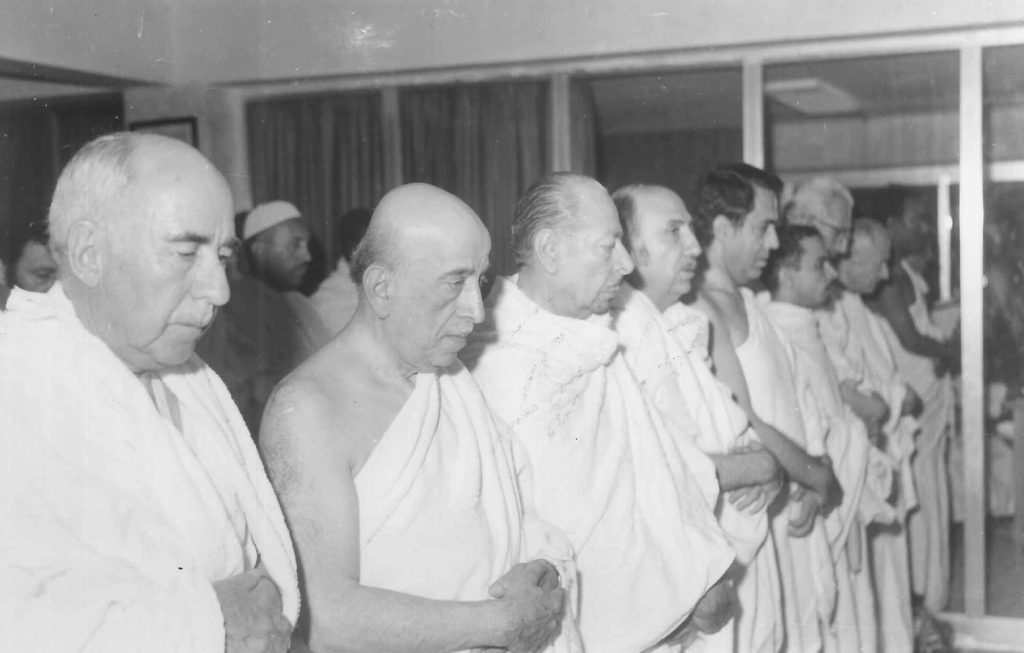
I visited him at this hotel, and he received my visit generously.
When his own circumstances and those of the region, which was going from bad to worse, pressed hard on him, he left Beirut for Cyprus and stayed at one of the hotels in its capital, where he was welcomed and honored by the official authorities.
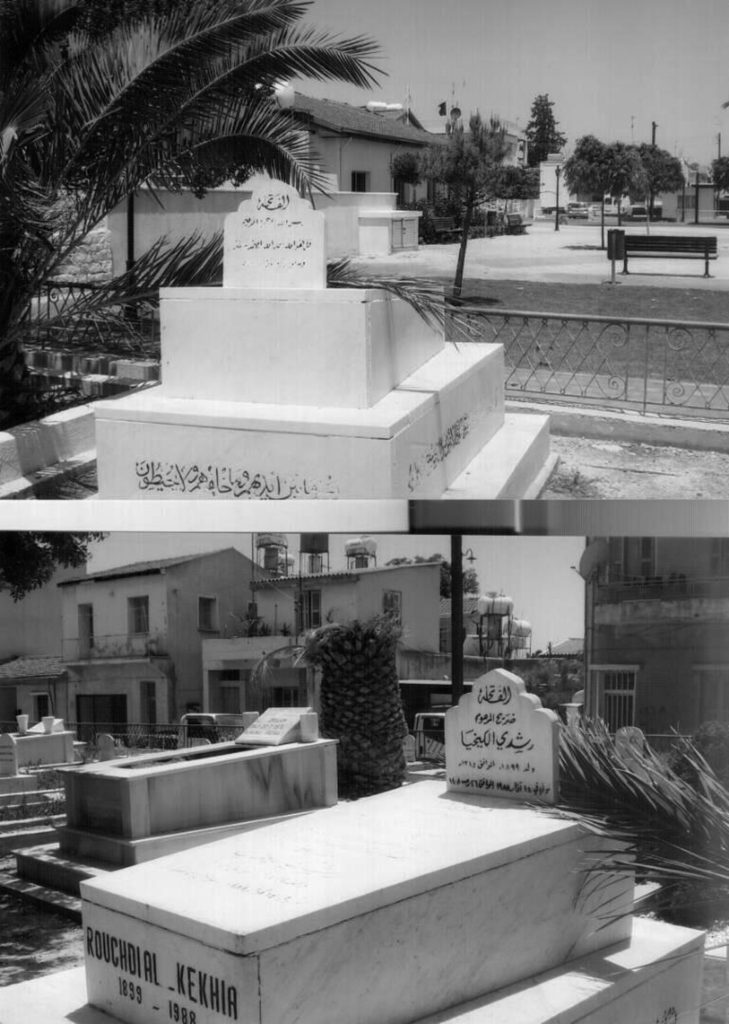
In Cyprus the decree of God, which none can turn back, came to him. He gave up his pure soul to its Creator in the arms of his nephew Marwan, and his body was laid to rest at one of its mosques, in which the name of God Almighty is remembered, on 14 March 1988.
The island of Cyprus had been part of the Ottoman Sultanate. Britain bought it from the Sultanate in 1878 and made it a colony. Turkish Cypriots settled in the town of Limassol, and one of the Cypriot Muslims, named Karanakut, built a mosque there that still bears his name.
In 1960 a civil war broke out between the Greek Cypriots and the Turkish Cypriots, and the garden of the mosque was turned into a cemetery for Muslim martyrs. In this cemetery the late al-Kikhya was buried.
On the day of his death, God rest him, I was in the city of Riyadh on a private visit to my son Ghassan, who was working as an engineer at the Arab Satellite Communications Organization (Arabsat).
The painful news was brought to me by Dr. Maarouf al-Dawalibi, adviser at the Saudi Royal Court.. and I felt hot tears falling on my cheeks in grief and sorrow.
And I asked myself: was it a stroke of fate that the soil of Cyprus should cover his pure body, or was he remembering the last wish of that Roman commander to his officers when he was mortally wounded on horseback amid the clash of swords:
"If I die, do not bury me in Rome, for it does not deserve my bones."
May God enfold you in His wide mercy, my dear friend.
And may He give you a home in His spacious gardens..
For you kept yourself clean of the world and its pleasures..
And turned away from the highest offices, which came running to you.
And you bore from the injustice of time and its people what would weigh down the truthful and the righteous.
But it is God's mercy upon you that you left the world while your memory remains in it like the spring breezes laden with the scent of roses.
And your reputation is purer than the water of the sky.
And your hand is white without blemish, because it never reached out for forbidden wealth.
And your nation, which you loved and for whose glory and unity you struggled, will always remember you with gratitude and loyalty.
Until God inherits the earth and all who are on it..
For the scum passes away as worthless, while what benefits people remains on the earth.
And peace be upon you the day you were born, the day you died and the day you are raised alive.
And this book is my offering to you, an unbroken and ever-renewed Fatiha for your pure soul.
(...Our Lord, do not take us to task if we forget or err...)
Damascus, at the beginning of the year 2000
Endnotes:
[1] Some friends of the late al-Bitar told me that he regretted bitterly, with the remorse of al-Kusa'i, having signed this document, and they assured me that he tried twice to kill himself.
[2] From his memorandum mentioned earlier. Mr. al-Kourani confirmed this account in his book "Dhikrayat wa Khawatir" (Memories and Reflections), Riad El-Rayyes press, London, February 2000, p. 344. Mr. al-Kourani's testimony is a categorical denial of the statement in Mr. Akram al-Hourani's memoirs "Sanawat al-Thalj wal-Nar" that Rushdi al-Kikhya, together with Nazim al-Qudsi, signed the statement endorsing the secession.
Al-Sharq al-Awsat newspaper, installment 30 of al-Hourani's memoirs.. These memoirs were printed in Egypt in 2000 by the press of al-Hajj Muhammad Madbouly.